
Coal

Coal guides for industrial buyers: grades, quality checks, pricing and sourcing Indonesian thermal coal.

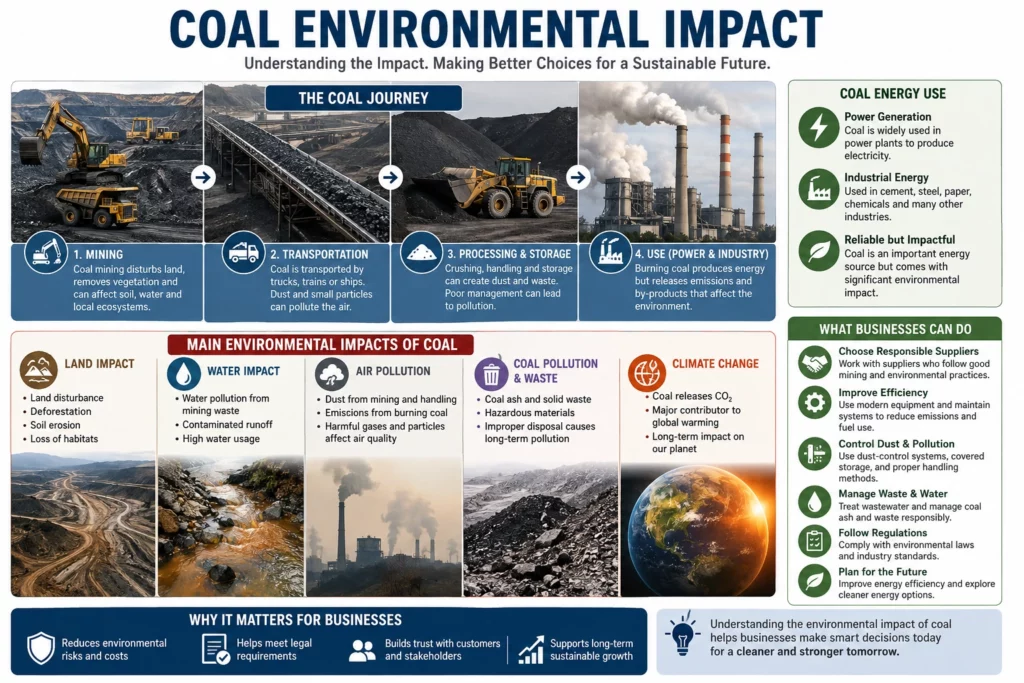
Infographic on the environmental impact of coal across mining, transport and combustion, with ways to reduce it

Environmental Impact of Coal in Industry and How to Reduce It

Coal affects the environment at every stage: mining, transport, storage and, above all, combustion. Burning coal releases carbon dioxide, sulphur dioxide (SO2), nitrogen oxides (NOx), particulates and mercury. Coal has the highest CO2 emissions per unit of energy of the major fossil fuels. Industrial users cannot remove every impact, but proven technologies and better coal

Environmental Impact of Coal in Industry and How to Reduce It Read More »

Coal-fired power plant with smoking chimneys beside a coal stockpile

How to Improve Efficiency in Coal-Fired Power Plants

A coal power plant’s efficiency is the share of the coal’s energy that leaves as electricity. Older subcritical units typically convert roughly a third of the fuel’s energy into power, while modern ultra-supercritical units reach the mid-40s in percentage terms. Every point of efficiency gained means less coal burned, lower fuel costs and lower emissions

How to Improve Efficiency in Coal-Fired Power Plants Read More »

Workers in hard hats and high-visibility vests at an open-pit coal mine with a haul truck and conveyor

Top Coal Exporting Countries in 2026: Where Should You Buy From?

Indonesia and Australia dominate world coal exports. Indonesia is the largest exporter of thermal coal for power plants. Australia is the largest exporter of metallurgical coal for steelmaking and the second-largest for thermal coal. Russia, Colombia, South Africa, the United States, Canada and Mongolia make up most of the rest. Where you buy from depends

Top Coal Exporting Countries in 2026: Where Should You Buy From? Read More »

Coal pouring from a conveyor onto a stockpile at a port, with a ship behind

The Benefits of Low-Sulphur Coal for Industry and Power Plants

Low-sulphur coal produces less sulphur dioxide (SO2) when it burns. That makes it easier for power plants, cement kilns and industrial boilers to meet emission limits, reduces corrosion in boilers and chimneys, and lowers the cost of running flue gas scrubbers. For many plants, choosing low-sulphur coal is the simplest and cheapest way to cut

The Benefits of Low-Sulphur Coal for Industry and Power Plants Read More »