
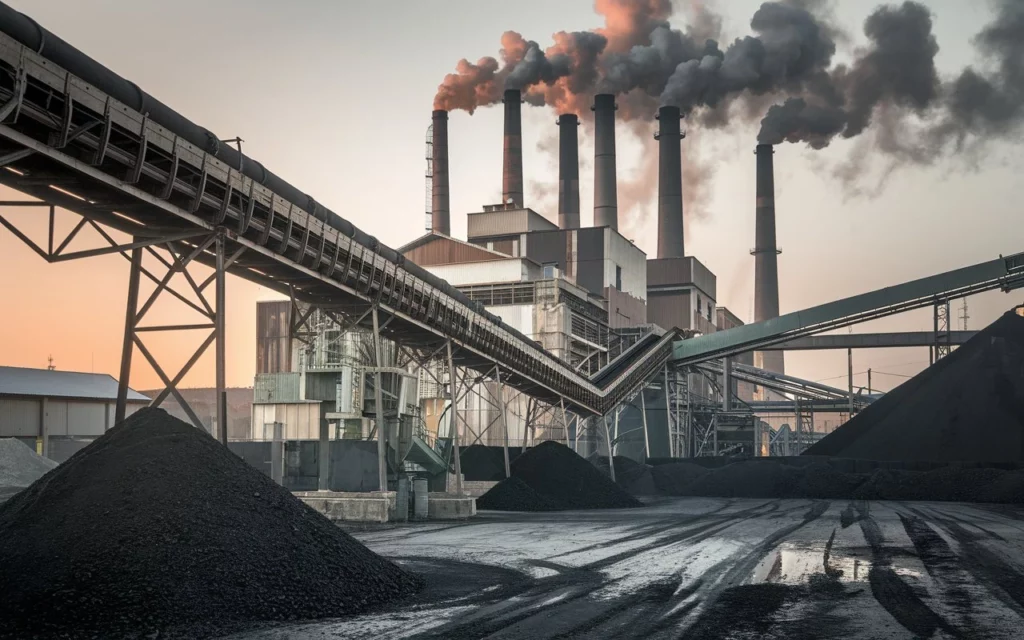
A coal power plant’s efficiency is the share of the coal’s energy that leaves as electricity. Older subcritical units typically convert roughly a third of the fuel’s energy into power, while modern ultra-supercritical units reach the mid-40s in percentage terms. Every point of efficiency gained means less coal burned, lower fuel costs and lower emissions per megawatt-hour.
Some gains need major investment. Many do not: they come from buying the right coal, tuning combustion and keeping the plant in good condition.

Why efficiency matters
- Fuel cost: coal is usually the largest operating cost of a coal plant.
- Emissions: the IEA has noted that each percentage point of efficiency gained cuts CO2 emissions by roughly 2% to 3%.
- Capacity: a well-run unit can deliver its rated output more reliably.
The usual measure is heat rate: how much fuel energy is needed to generate one kilowatt-hour. A lower heat rate means a more efficient plant.
1. Buy coal that matches the boiler
This is often the cheapest improvement. Every boiler is designed for a range of coal properties. Coal outside that range costs efficiency:
- High moisture wastes energy evaporating water and lowers boiler efficiency.
- High ash increases wear, slagging and ash handling, and reduces heat transfer.
- Wrong volatile matter can make ignition and flame stability harder.
- Poor grindability (low HGI) limits mill capacity in pulverised-coal boilers.
- Low ash fusion temperature causes slagging and fouling.
Compare coal offers on delivered cost per unit of energy, and check the full specification. See how to assess coal quality and key factors when buying coal for power generation.
2. Tune combustion
- Excess air: too much air carries heat up the stack; too little leaves unburned carbon. Optimise it continuously.
- Coal fineness: well-maintained mills and classifiers give the right particle size for complete burnout.
- Burner balance: even fuel and air distribution across burners improves combustion.
- Unburned carbon in ash: track it as a direct sign of combustion losses.
3. Keep heat transfer surfaces clean
Soot and slag on boiler tubes act as insulation. Effective sootblowing, guided by measurements rather than fixed schedules, keeps heat transfer high.
4. Reduce losses around the cycle
- Air heater leakage and condenser performance have a large effect on heat rate.
- Feedwater heaters must work as designed.
- Steam leaks and valve passing waste energy.
- Auxiliary power: fans, pumps and mills use a share of the plant’s own output. Variable speed drives can cut this.
5. Monitor heat rate continuously
Digital control systems and performance monitoring help operators see where efficiency is lost, shift by shift. Small, constant deviations add up over a year.
6. Upgrade steam conditions
For new plants and major retrofits:
- Supercritical and ultra-supercritical boilers run at higher steam pressures and temperatures, which raises efficiency.
- Turbine upgrades with modern blade designs can recover several points of efficiency on older units.
These are large investments, usually justified only for plants with a long remaining life.
Efficiency and coal choice: an example
Two coals can have the same price per tonne but very different value. A coal with lower moisture and ash may give more electricity per tonne and fewer maintenance problems, which can outweigh a higher purchase price. That is why many plants buy on a specification with price adjustments for calorific value, and rejection limits for ash and moisture.
Buying coal for power plants through Agromer
Agromer holds mandates for Indonesian thermal coal for power plants and industrial buyers. Indonesian coal is typically low in ash and sulphur. We work with an end-buyer LOI, payment by 100% DLC or SBLC, and SGS inspection at loading. Send us your boiler’s design coal range, monthly quantity, contract length and discharge port. See coal suppliers for power plants and our Indonesian coal supply page.
Frequently asked questions
What is the efficiency of a coal power plant?
Older subcritical plants convert roughly a third of the coal’s energy to electricity. Modern ultra-supercritical plants reach the mid-40s in percentage terms.
What is heat rate?
The fuel energy needed to generate one kilowatt-hour of electricity. A lower heat rate means higher efficiency.
How does coal quality affect efficiency?
High moisture and ash lower boiler efficiency and increase wear. Coal that matches the boiler’s design range burns most efficiently.
What is the cheapest way to improve efficiency?
Usually better coal selection, combustion tuning, cleaning heat transfer surfaces and fixing leaks, before any major upgrade.
What is an ultra-supercritical boiler?
A boiler that runs at very high steam pressure and temperature, giving higher efficiency than subcritical or supercritical designs.
Does higher efficiency reduce emissions?
Yes. Burning less coal for the same output reduces CO2 and other emissions.