
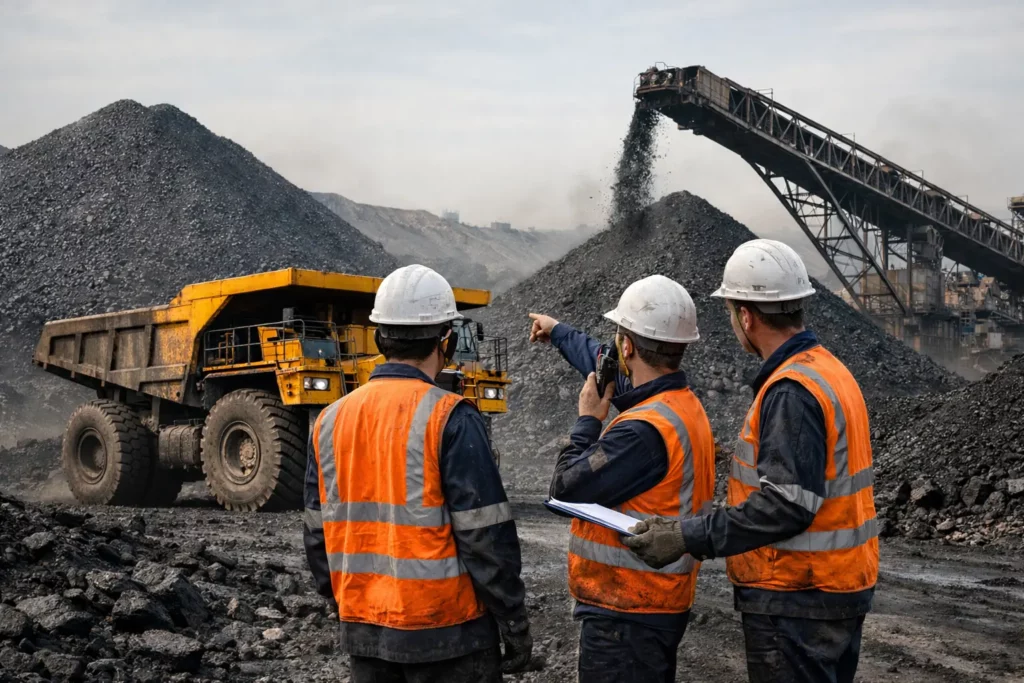
Indonesia and Australia dominate world coal exports. Indonesia is the largest exporter of thermal coal for power plants. Australia is the largest exporter of metallurgical coal for steelmaking and the second-largest for thermal coal. Russia, Colombia, South Africa, the United States, Canada and Mongolia make up most of the rest.
Where you buy from depends on the coal you need, your port, and how much supply risk you can accept. This guide compares the main exporting countries using the latest IEA figures.

The largest coal exporters at a glance
| Country | Thermal coal exports 2025 | 2026 IEA forecast | Main coal type |
|---|---|---|---|
| Indonesia | 517 Mt (557 Mt in 2024) | About 495 Mt | Sub-bituminous thermal, low ash and low sulphur |
| Australia | 209 Mt, plus about 142 Mt of metallurgical coal | About 216 Mt | High-energy thermal and premium coking coal |
| Russia | About 130 Mt | About 132 Mt | Bituminous thermal; trade affected by sanctions |
| Colombia | 45 Mt, the lowest since 2003 | Recovery expected | Bituminous thermal for Atlantic buyers |
| South Africa, United States | Smaller volumes | Thermal and, for the US, metallurgical |
Seaborne thermal coal demand is projected at about 1,062 Mt in 2026, down slightly from about 1,074 Mt in 2025, according to the IEA.
Country by country
1. Indonesia
Indonesia is the world’s largest thermal coal exporter. Its coal is mostly sub-bituminous, with lower calorific value and higher moisture than Australian coal, but low ash and low sulphur. That makes it popular with power plants in China, India and Southeast Asia, which are close by and can burn it efficiently. Prices are set against the Indonesian Coal Index (ICI).
Exports fell in 2025, and the IEA expects a further decline in 2026 as government policy on production quotas, permits and export levies tightens. Read more in our guide to Indonesian coal and Indonesian coal prices.
2. Australia
Australia exports high-energy bituminous thermal coal, priced against the Newcastle benchmark, and is the world’s leading supplier of coking coal for steel mills. Its main buyers are Japan, South Korea, Taiwan, India and China. Australian coal is high quality but usually carries a higher price.
3. Russia
Russia exports bituminous thermal coal and some coking coal, mostly through its Far East and Baltic ports. Sanctions have shut it out of the EU and some other markets, so most exports now go to Asia and Turkey. Buyers need to check the sanctions rules that apply to them.
4. Colombia
Colombia exports bituminous thermal coal, mainly to Atlantic-basin buyers in Europe, the Mediterranean and Latin America. Exports fell to 45 Mt in 2025. Cerrejón, the largest mine, declared force majeure on 1 June 2026, a reminder that single-origin supply carries risk.
5. South Africa
South Africa ships thermal coal from Richards Bay, mainly to India, Pakistan and other Asian buyers. Rail problems on the export corridor have limited volumes in recent years.
6. United States
The US exports both thermal and metallurgical coal, from ports on the East Coast and Gulf. US coking coal is an important supply for steel mills in Asia, Europe and Latin America.
7. Canada
Canada exports mainly metallurgical coal from British Columbia, through Pacific ports to Asian steelmakers.
8. Mongolia
Mongolia exports coking and thermal coal almost entirely to China by rail and road. Its growing sales are one reason Chinese seaborne imports are expected to soften in 2026.
9. Kazakhstan
Kazakhstan exports thermal coal, mostly by rail to Russia, Central Asia and Europe.
10. Mozambique
Mozambique is a smaller exporter of coking and thermal coal, mainly to India and Asia through the port of Nacala.
What prices look like in 2026
| Benchmark | 2025 average | September 2026 |
|---|---|---|
| Australian thermal coal (Newcastle) | $108.40 | $147.10 |
| South African thermal coal (Richards Bay) | $94.90 | $98.20 |
Indonesian 4,200 kcal/kg coal rose from about $45 per tonne FOB at the start of 2026 to about $66 per tonne by the end of August, according to the IEA.
How to choose where to buy from
- Match the coal to your boiler or furnace. Power plants built for sub-bituminous coal run well on Indonesian grades. Steel mills need coking coal, mainly from Australia, the US or Canada. See understanding coal grades.
- Compare delivered cost, not FOB price. Freight can change which origin is cheapest. Indonesian coal is often the best value for buyers in Asia.
- Check the specification. Calorific value, total moisture, ash, sulphur and size all matter. See how to assess coal quality.
- Spread the risk. A second origin, clear force majeure terms and an agreed price index reduce the impact of disruptions.
- Check sanctions and compliance for each origin and route.
For power plants, see also coal suppliers for power plants.
Buying Indonesian coal through Agromer
Agromer holds mandates for Indonesian thermal coal for power plants and industrial buyers. We work with an end-buyer LOI, payment by 100% DLC or SBLC, and SGS inspection at loading. Send us the specification, monthly quantity, contract length and discharge port. See our Indonesian coal supply page.
Frequently asked questions
Which country is the largest coal exporter?
Indonesia is the largest exporter of thermal coal, with 517 Mt in 2025. Australia is the largest exporter of metallurgical coal and second for thermal coal.
Which country exports the best quality coal?
It depends on the use. Australia, the US and Canada supply premium coking coal for steel. Australian, Colombian and Russian thermal coal has high energy content. Indonesian coal has lower energy but is low in ash and sulphur.
Why is Indonesian coal cheaper?
It has lower calorific value and higher moisture, and it is close to major Asian buyers, which cuts freight costs.
Does China export coal?
Very little. China is the world’s largest coal producer and importer, and uses almost all its coal at home.
Are coal exports falling?
The IEA expects seaborne thermal coal demand to ease slightly in 2026, to about 1,062 Mt, and Indonesian exports to fall to about 495 Mt.
Can I buy Russian coal?
It depends on where you are. Sanctions restrict Russian coal in the EU and some other markets. Check the rules that apply to your company and route.