
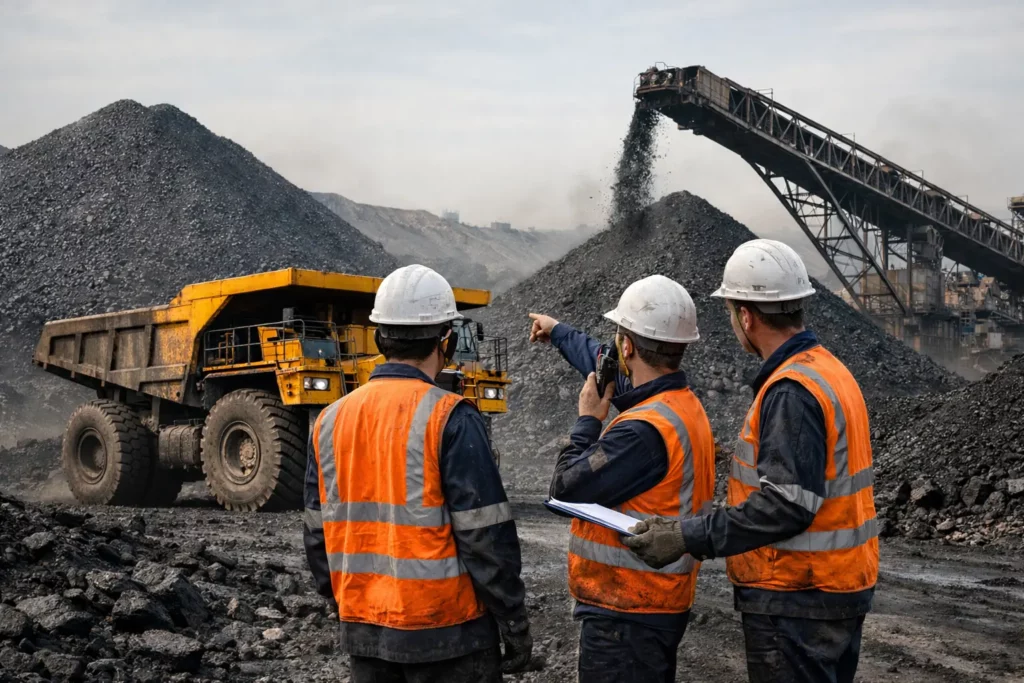
Indonesia is the world’s largest exporter of thermal coal, the coal burned in power plants and industrial boilers. It exported about 514 to 517 million tonnes in 2025, according to the Indonesian energy ministry and the IEA. Most of it is sub-bituminous coal: lower in energy than Australian coal, but low in ash and sulphur, competitively priced and close to the big Asian buyers.
Agromer holds mandates for Indonesian thermal coal and supplies power plants and industrial buyers on FOB and CIF terms.

Indonesian coal at a glance
| Detail | |
|---|---|
| Production 2025 | 790 Mt (836 Mt in 2024), energy ministry |
| Thermal coal exports 2025 | About 514 to 517 Mt |
| 2026 export forecast | About 495 Mt (IEA) |
| Main mining regions | East and South Kalimantan, South Sumatra |
| Main coal type | Sub-bituminous thermal coal |
| Typical strengths | Low ash, low sulphur, competitive price |
| Main buyers | China, India, Southeast Asia, Japan, South Korea, Taiwan |
Grades of Indonesian coal
Indonesian coal is graded by calorific value (CV). The Indonesian Coal Index tracks five reference grades:
| Grade | Calorific value (GAR) | Typical use |
|---|---|---|
| ICI 1 | 6,500 kcal/kg | High-efficiency plants, blending |
| ICI 2 | 5,800 kcal/kg | Power and industry |
| ICI 3 | 5,000 kcal/kg | Power plants, cement |
| ICI 4 | 4,200 kcal/kg | Large power plants in Asia |
| ICI 5 | 3,400 kcal/kg | Nearby and mine-mouth plants, blending |
The lower grades carry a lot of moisture, which reduces energy per tonne, but they are typically very low in ash and sulphur. See coal grades explained.
What to put in your specification
- Calorific value with its basis: GAR, NAR or ADB
- Total moisture (as received)
- Inherent moisture, ash, volatile matter and fixed carbon (proximate analysis)
- Total sulphur
- HGI (grindability) for pulverised-coal boilers
- Ash fusion temperature
- Size, usually 0 to 50 mm, with a maximum oversize
For each, agree a typical value, a rejection limit and any price adjustment. Read how to assess coal quality.
Indonesian coal prices in 2026
Prices are usually set against the Indonesian Coal Index (ICI) for the nearest grade. According to the IEA, 4,200 kcal/kg GAR coal rose from about $45 per tonne FOB at the start of 2026 to about $66 per tonne by the end of August. The government also publishes a monthly reference price, the HBA, used for royalties. For more detail, see Indonesian coal price per ton.
Why buyers choose Indonesian coal
- Price: lower cost per tonne than higher-energy coals, and often competitive per unit of energy for Asian buyers
- Low ash and sulphur: helps plants meet emission limits and reduces ash handling
- Location: short voyages to China, India and Southeast Asia
- Range of grades: from about 3,400 to 6,500 kcal/kg GAR
The trade-offs are higher moisture and lower energy, so the boiler must be suited to the grade. See the benefits of low-sulphur coal.
Supply risks to watch
- Policy: production quotas, export levies and permit rules can change availability
- Weather: heavy rain can slow mining and barge loading
- Logistics: most coal moves by river barge to anchorages before loading onto ocean vessels
See mining and extraction of Indonesian coal and how to secure a reliable coal supply chain.
How buying through Agromer works
- Enquiry: send your specification, monthly quantity, contract length and discharge port.
- End-buyer LOI: required before an offer is issued.
- Offer and contract: grade, quantity, price basis and delivery terms.
- Payment: 100% DLC or SBLC.
- Inspection: SGS at loading for quality and quantity.
See also coal suppliers for power plants and our Indonesian coal supply page.

Frequently asked questions
What type of coal does Indonesia produce?
Mostly sub-bituminous thermal coal, with some higher-energy bituminous grades. It is used mainly for power generation.
How much coal does Indonesia export?
About 514 to 517 million tonnes of thermal coal in 2025, making it the world’s largest thermal coal exporter.
What is GAR 4200 coal?
Indonesian coal with a gross calorific value of about 4,200 kcal/kg as received. It is one of the most traded grades and the basis of the ICI 4 index.
Is Indonesian coal low in sulphur?
Most Indonesian export coal is low in sulphur and ash, which is one of its main advantages.
Who buys Indonesian coal?
Mainly China, India, Southeast Asian countries, Japan, South Korea and Taiwan.
How is Indonesian coal priced?
Usually against the Indonesian Coal Index for the nearest grade, adjusted for actual quality, plus freight for CFR or CIF delivery.