

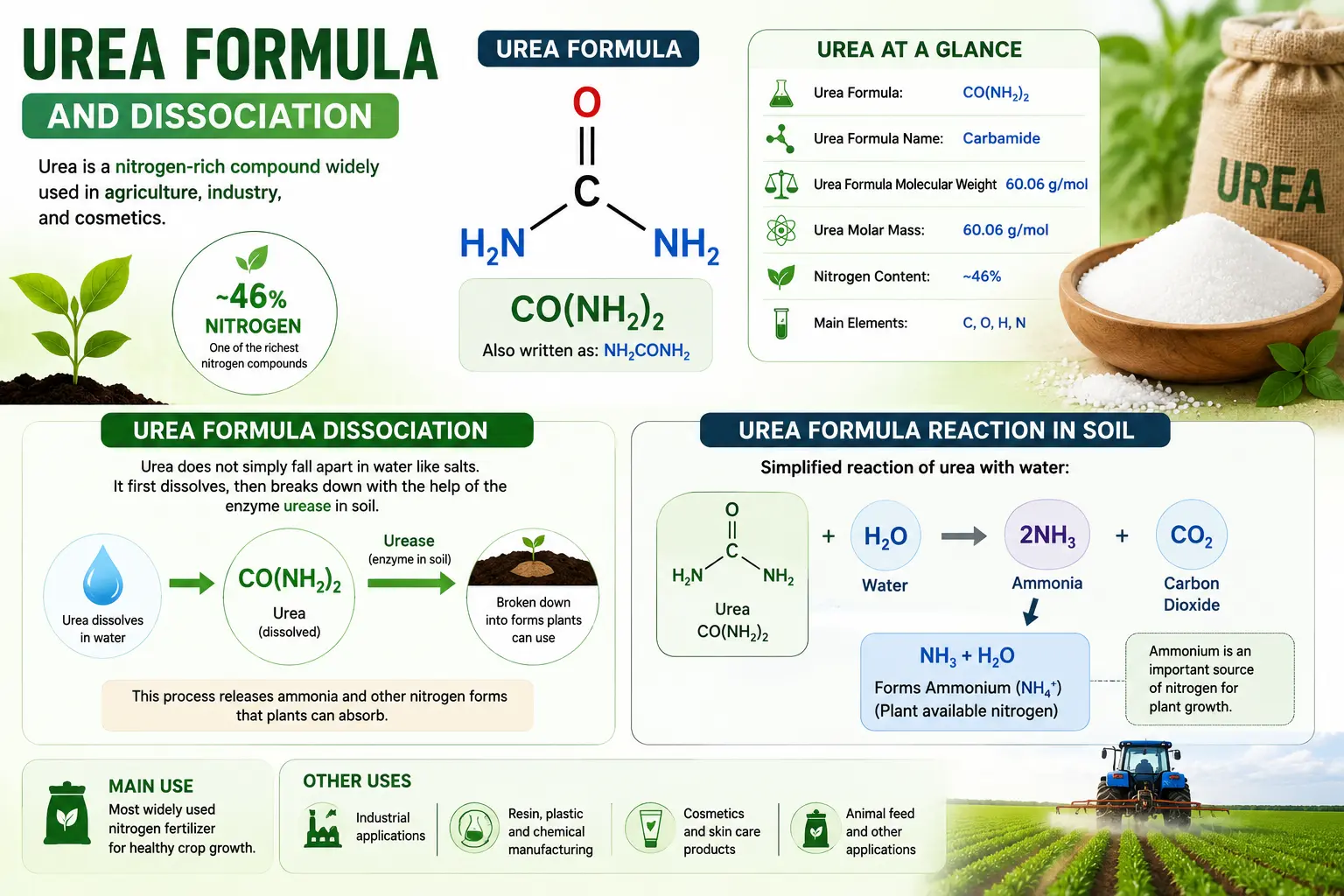
Urea powder is the fine crystalline form of urea (carbamide, CO(NH2)2), a white, odourless and highly water-soluble compound containing about 46% nitrogen. The same molecule is sold in very different grades: fertilizer urea for crops, technical urea for resins and chemicals, high-purity urea for AdBlue/DEF, feed-grade urea for ruminants and pharmacopoeia grades for creams and medicines. The grade, not the molecule, decides what you can use it for.
This guide explains each grade, the specifications that matter, how urea is made and stored, and what to include in a bulk enquiry.
Key facts at a glance
| Property | Value |
|---|---|
| Chemical name | Urea (carbamide) |
| Formula | CO(NH2)2, also written NH2CONH2 |
| Molar mass | 60.06 g/mol |
| Nitrogen content | 46.6% in pure urea; commercial fertilizer grade is sold as 46% N |
| Melting point | About 133 °C |
| Solubility in water | Very high, roughly 1,080 g per litre at 20 °C |
| Appearance | White crystals, powder, prills or granules |
| HS code | 3102.10 (urea, whether or not in aqueous solution); national subheadings vary |
Powder, prills or granules: what is the difference?
All three are urea; they differ in particle size and handling.
- Powder or crystals dissolve fastest and mix evenly, so they are preferred for industrial processes, AdBlue production, laboratories and formulations.
- Prills (small spheres, about 1–2 mm) are formed by spraying molten urea down a prilling tower. They are widely used as fertilizer and for some industrial dissolving.
- Granules (about 2–4 mm) are harder and more uniform, so they spread better and resist dust and caking. Most fertilizer urea traded today is granular.
For the farming side of this question, see liquid vs granular urea.
Urea grades and what they are used for
| Grade | Main uses | Specifications that matter | Watch out for |
|---|---|---|---|
| Fertilizer (agricultural) | Nitrogen fertilizer for cereals, sugarcane and most crops; raw material for NPK blends | 46% N minimum, biuret, moisture, granule size | Often coated with an anti-caking agent, which can make it unsuitable for other uses |
| Technical (industrial) | Urea-formaldehyde and melamine resins, adhesives, textiles, chemicals | Purity, low biuret, low free ammonia, particle size | Check additives against your process |
| DEF / AdBlue | AUS 32 solution for diesel SCR systems | Must allow the solution to meet ISO 22241: very low biuret, aldehydes and metals | Ordinary fertilizer urea is not suitable |
| Feed | Non-protein nitrogen for ruminants such as cattle | Feed-grade specification and registration | Only for ruminants, at controlled rates set by a nutritionist |
| Pharmaceutical / cosmetic | Moisturisers, keratolytic creams, medical products | Compliance with a pharmacopoeia monograph (e.g. Ph. Eur., USP) | Requires documented, GMP-traceable supply |
Fertilizer urea

Fertilizer urea is the most concentrated solid nitrogen fertilizer, which is why it is the most widely used nitrogen source in agriculture. In soil it is converted to ammonium; left on the surface, some of that nitrogen can be lost as ammonia, so it should be incorporated or watered in. Read urea fertilizer: bulk supply and export, how to use urea as fertilizer and urea compared with DAP and NPK.
Technical and industrial urea

The largest industrial use of urea is urea-formaldehyde resin, the binder in particleboard, MDF and plywood. Urea is also a raw material for melamine and is used in textile processing and other chemical production. Buyers usually specify purity, biuret, free ammonia and particle size. More in technical grade urea.
Urea for AdBlue / DEF
AdBlue (AUS 32) is a solution of about 32.5% high-purity urea in demineralised water, used in selective catalytic reduction (SCR) systems to cut nitrogen oxide emissions from diesel engines. The finished solution must meet ISO 22241, which sets strict limits on biuret, aldehydes and metals that could damage the catalyst. That is why ordinary fertilizer urea, often treated with formaldehyde as an anti-caking agent, cannot be used. See urea for AdBlue, DEF urea and how urea reduces vehicle emissions.
Cosmetic and pharmaceutical urea
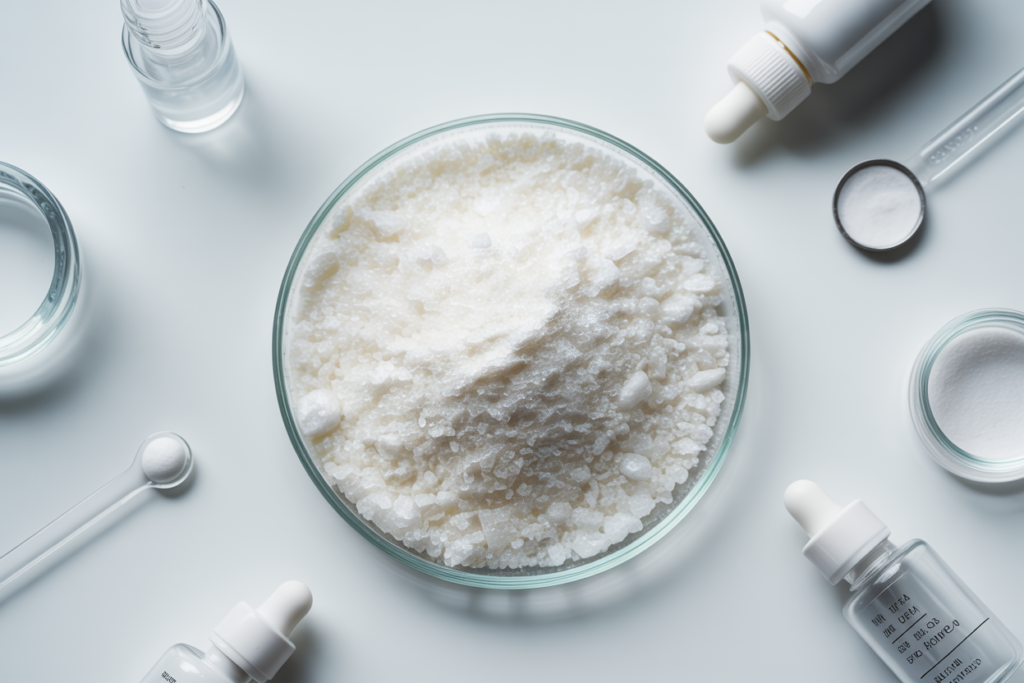
In skincare, urea is a humectant that draws water into the skin and, at higher concentrations, softens thickened skin. Everyday moisturisers commonly contain up to about 10%, while products for very rough or calloused skin use more. Cosmetic and medical manufacturers buy urea that meets a pharmacopoeia monograph, with full documentation. Read cosmetic urea and what urea is used for.
How urea is made

Almost all urea is made from ammonia and carbon dioxide, both usually produced in the same plant from natural gas.
- Synthesis: ammonia and carbon dioxide react at high pressure (roughly 140–200 bar) and about 180–200 °C to form ammonium carbamate.
- Dehydration: the carbamate loses water to form urea: 2NH3 + CO2 → NH2COONH4 → CO(NH2)2 + H2O.
- Concentration: the urea solution is evaporated to a melt. Holding it hot for too long forms biuret, an impurity that every specification limits.
- Finishing: the melt is prilled or granulated, or crystallised and milled into powder for industrial and high-purity uses.
For more detail, see the urea manufacturing process.
Storage and handling
- Keep it dry. Urea is hygroscopic: in humid air it absorbs moisture and cakes. Store in sealed or lined bags, on pallets, in a dry, ventilated warehouse.
- Keep grades separate. Never let fertilizer urea contaminate DEF or pharmaceutical stock.
- Read the SDS from your supplier before handling, and avoid storing urea next to strong oxidisers or acids.
- A curious fact: dissolving urea in water absorbs heat, so the solution becomes noticeably cold.
What drives urea prices?
Urea prices change frequently. The main drivers are natural gas prices (the main production cost), export policies in major producing countries, large import tenders, freight rates and the farming season. Higher-purity grades for DEF, cosmetics or pharmaceuticals carry a premium over fertilizer urea. For context, see technical grade urea price per ton and the cost of urea fertilizer; for a current offer, ask for a quotation.
Buying urea in bulk: what to specify

- Grade and standard: fertilizer, technical, DEF (ISO 22241), feed or a named pharmacopoeia
- Key limits: nitrogen or purity, biuret, moisture, free ammonia, additives such as formaldehyde
- Form: powder, prills or granules, and particle size
- Packaging: 25 or 50 kg bags, one-tonne big bags, or bulk
- Quantity and schedule, destination port and delivery terms (for example FOB or CIF)
- Documents: certificate of analysis, safety data sheet and inspection at loading
Before you commit, check the supplier and the documents: our guide on how to assess suppliers before importing explains the checks.
Agromer trades urea through major refineries on spot and contract terms. Offers are issued as a full corporate offer (FCO) against an end-buyer Letter of Intent. For technical, DEF or other grades, send the exact specification and we will confirm whether a suitable source is available.
Frequently asked questions
What is urea powder?
Urea powder is urea (carbamide, CO(NH2)2) in fine crystalline form. It is white, odourless, highly soluble in water and contains about 46% nitrogen. It is used as a fertilizer, an industrial raw material, a component of AdBlue/DEF, a ruminant feed additive and an ingredient in skincare and medical products, depending on grade.
How much nitrogen does urea contain?
Pure urea contains 46.6% nitrogen. Commercial fertilizer urea is sold as 46% N, the highest nitrogen content of any common solid fertilizer.
Can fertilizer urea be used to make AdBlue?
No. AdBlue must meet ISO 22241, which sets strict limits on biuret, aldehydes and metals. Fertilizer urea often contains formaldehyde-based anti-caking agents and higher impurity levels, so AdBlue is made from high-purity technical urea.
What is the difference between urea prills and urea powder?
Both are urea. Prills are small spheres of about 1 to 2 mm, mainly used as fertilizer. Powder is finely crystalline or milled, dissolves faster and is preferred for industrial processes, solutions and formulations.
What is the HS code for urea?
Urea is classified under HS 3102.10, urea whether or not in aqueous solution. Countries add their own national subheadings, so confirm the full code with your customs broker.
How should urea be stored?
Keep urea in sealed or lined bags or big bags, on pallets, in a dry and ventilated warehouse. It absorbs moisture from humid air and cakes. Store different grades separately.
Why does water get cold when urea dissolves?
Dissolving urea is endothermic: it absorbs heat from the water, so the solution cools noticeably.
How can I buy urea in bulk from Agromer?
Send the grade, specification, quantity, packaging, destination and delivery terms through the quote request form. For urea, an end-buyer Letter of Intent is required before a full corporate offer is issued.