
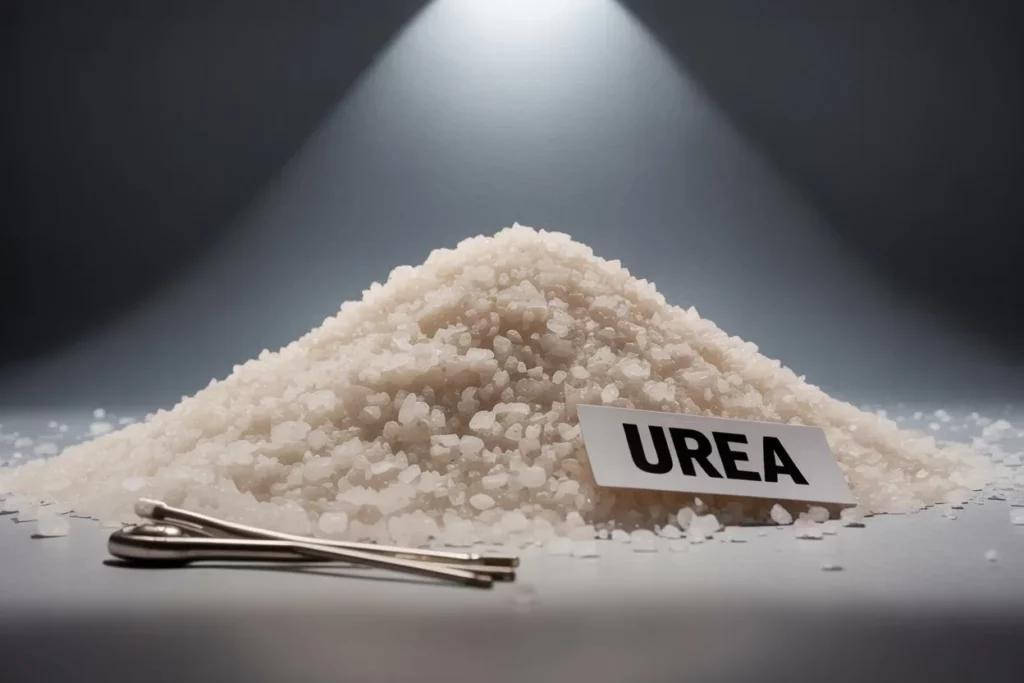
Technical grade urea is high-purity urea made for industrial use rather than for fertilizer. It is typically 99% urea or more, with tightly controlled biuret, moisture and impurities. Industries use it to make resins and adhesives, AdBlue, chemicals, textiles and many other products.
The chemistry is the same as farm urea. The difference is control: a resin plant or an AdBlue blender needs every lot to behave the same way, so the specification matters far more than for a farmer’s field.
Technical vs industrial vs fertilizer urea

| Technical grade | Industrial grade | Fertilizer grade | |
|---|---|---|---|
| Purity | Highest, typically 99% or more | High | Lower |
| Biuret | Low | Controlled | Higher (up to 1.5% in some fertilizer standards) |
| Additives | Usually none | Varies | Often anti-caking agents or coatings |
| Main uses | AdBlue, resins, chemicals, pharma, cosmetics | Bulk manufacturing processes | Crop nutrition |
For a wider overview of grades, see urea powder: grades and uses.
Typical technical grade urea specification
| Parameter | Typical value |
|---|---|
| Urea content | 99% minimum |
| Total nitrogen | 46% minimum |
| Biuret | Low, set by the end use (stricter for AdBlue production) |
| Moisture | 0.5% maximum or lower |
| Form | White prills, granules or crystals |
| Melting point | About 132 to 135 °C |
| Solubility | Fully soluble in water |
What technical grade urea is used for

- Resins and adhesives: urea-formaldehyde resins for plywood, particle board and laminates, and as a raw material for melamine
- Automotive: making AdBlue (diesel exhaust fluid) for SCR systems; see DEF urea and urea for AdBlue
- Chemicals: feedstock for other chemicals and a reagent in laboratories
- Cosmetics and pharmaceuticals: moisturising creams and skin treatments; see cosmetic urea
- Textiles and dyes: helps dyes absorb and fix
- Other uses: de-icing at airports, and controlled use in animal feed
Can fertilizer urea be used instead?
Not for demanding uses. Fertilizer urea can contain more biuret, anti-caking agents such as urea-formaldehyde, or coatings such as neem. These cause problems in AdBlue, resins and cosmetics. Keep technical and fertilizer grades separate from production to delivery.
Storage and handling
- Store in a cool, dry, well-ventilated place, away from direct sunlight.
- Keep bags sealed; urea absorbs moisture and cakes.
- Use gloves and eye protection when handling, and follow the supplier’s safety data sheet.
- Typical packaging: 25 or 50 kg bags, big bags (jumbo bags) or bulk.
What drives the price
Technical grade urea follows the global urea market, plus a premium for purity, testing and separate handling. The World Bank benchmark for granular urea averaged $407.50 per tonne in September 2026. See technical grade urea price per ton for current levels.
Buying technical grade urea
Agromer trades urea, including technical grades, for industrial buyers. Send us your specification (purity, biuret, moisture, metals), quantity, packaging and destination, and we will check what we can offer. Read how urea is made in our urea manufacturing process guide.
Frequently asked questions
What is technical grade urea?
High-purity urea, typically 99% or more, made for industrial uses such as resins, AdBlue, chemicals and cosmetics.
What is the difference between technical and fertilizer urea?
Technical urea is purer, with lower biuret and no anti-caking additives or coatings. Fertilizer urea is made to feed crops and allows more impurities.
Is technical grade urea used in AdBlue?
Yes. AdBlue (DEF) is made from high-purity technical or automotive grade urea dissolved in deionised water to meet ISO 22241.
How should technical grade urea be stored?
In sealed bags in a cool, dry, ventilated place, away from moisture and sunlight.
Is urea hazardous?
Urea has low toxicity and is not flammable, but dust can irritate the eyes and skin. Follow the safety data sheet.