
Cosmetic grade urea is high-purity urea made for skincare and personal-care products. It is the same molecule as fertilizer urea, CO(NH2)2, but produced and handled to much tighter purity and contamination limits. In creams and lotions it acts as a humectant, drawing water into the skin, and at higher levels as a keratolytic, softening thick, rough skin.
Urea is also part of the skin’s own natural moisturising factor, which is one reason it is so widely used in moisturisers.
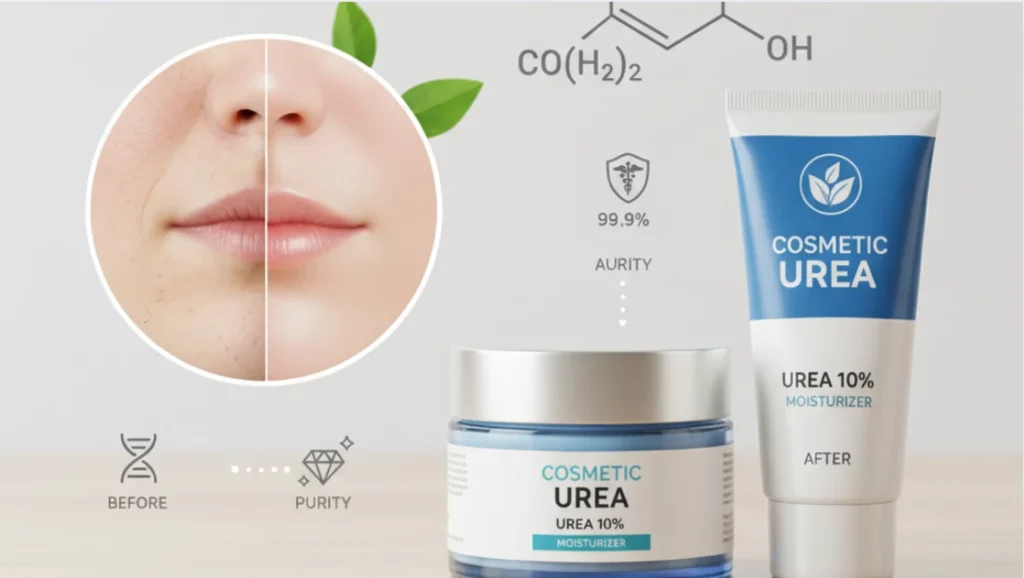
What urea does in skincare
| Typical level in a product | Main effect | Common uses |
|---|---|---|
| Up to about 10% | Humectant: helps skin hold water | Daily moisturisers, body lotions, hand creams |
| About 10% to 20% | Moisturising plus softening of rough skin | Dry-skin and foot creams |
| Above 20% | Strong keratolytic effect | Products for calluses, cracked heels and thick nails, often sold as medical or pharmacy products |
Urea is also used in shampoos, scalp products and some pharmaceutical ointments.
Cosmetic urea vs other grades
| Grade | Purpose | Key difference |
|---|---|---|
| Fertilizer urea | Supplying nitrogen to crops | Higher biuret, may contain anti-caking agents; not for skin products |
| Technical urea | Resins, chemicals, AdBlue | Low impurities, but not tested to pharmacopoeia standards |
| Cosmetic or pharmaceutical urea | Skincare, personal care, medicines | Tested against pharmacopoeia monographs; tight limits on impurities and heavy metals |
Pharmacopoeia grades
Cosmetic and pharmaceutical buyers usually specify urea that meets a pharmacopoeia monograph, such as:
- USP (United States Pharmacopeia)
- Ph. Eur. / EP (European Pharmacopoeia)
- BP (British Pharmacopoeia)
- IP (Indian Pharmacopoeia)
The monograph sets the tests and limits. Ask which edition the supplier’s certificate refers to.
What to check on the certificate of analysis
- Assay (urea content) against the stated monograph
- Biuret
- Ammonium
- Heavy metals or elemental impurities
- Sulphated ash and loss on drying
- Appearance, solubility and clarity of solution
- Particle size, if you need a fine powder
- Batch number, manufacturing date and retest date
For cosmetics sold in the EU, the finished product must also comply with the EU Cosmetics Regulation, so keep full traceability of each raw material lot.
How cosmetic urea is made
All urea is made from ammonia and carbon dioxide. They react under high pressure to form ammonium carbamate, which then loses water to form urea. For cosmetic and pharmaceutical grades, producers add purification and crystallisation steps, and test each batch against the relevant monograph. See how urea is made.
Cosmetic urea is synthetic. It is not made from animal sources.
Is urea safe in cosmetics?
Urea is widely used and generally well tolerated at normal cosmetic levels. Higher concentrations can sting broken or very sensitive skin, which is why strong keratolytic products are usually labelled for specific uses. Formulators should follow the applicable regulations and safety assessments in their market.
Sourcing cosmetic urea through Agromer
Agromer is a commodity trader based in Saint-Avertin, France, founded in 1985. We trade urea grades for industrial buyers and can look for cosmetic or pharmaceutical grade urea on request. Send us:
- The grade and monograph (USP, EP, BP or IP)
- Quantity and packaging
- Destination and delivery terms
- Any documents you need, such as a COA, safety data sheet or REACH information
We confirm availability, specification and documents in each offer. See also technical grade urea.
Frequently asked questions
What is cosmetic urea?
High-purity urea made and tested for skincare and personal-care products, usually to a pharmacopoeia standard such as USP or EP.
What does urea do for the skin?
At low levels it helps skin hold water. At higher levels it also softens and loosens thick, rough skin.
Is cosmetic urea made from urine?
No. Cosmetic urea is synthetic, made from ammonia and carbon dioxide.
What is the difference between cosmetic and fertilizer urea?
They are the same molecule, but cosmetic urea is purified and tested to much tighter limits. Fertilizer urea is not suitable for skin products.
What concentration of urea is used in creams?
Daily moisturisers often use up to about 10%. Foot and callus products use higher levels, sometimes above 20%.
Which standards apply to cosmetic urea?
Buyers usually specify a pharmacopoeia grade such as USP, Ph. Eur., BP or IP, plus the cosmetic regulations of the market where the product is sold.