
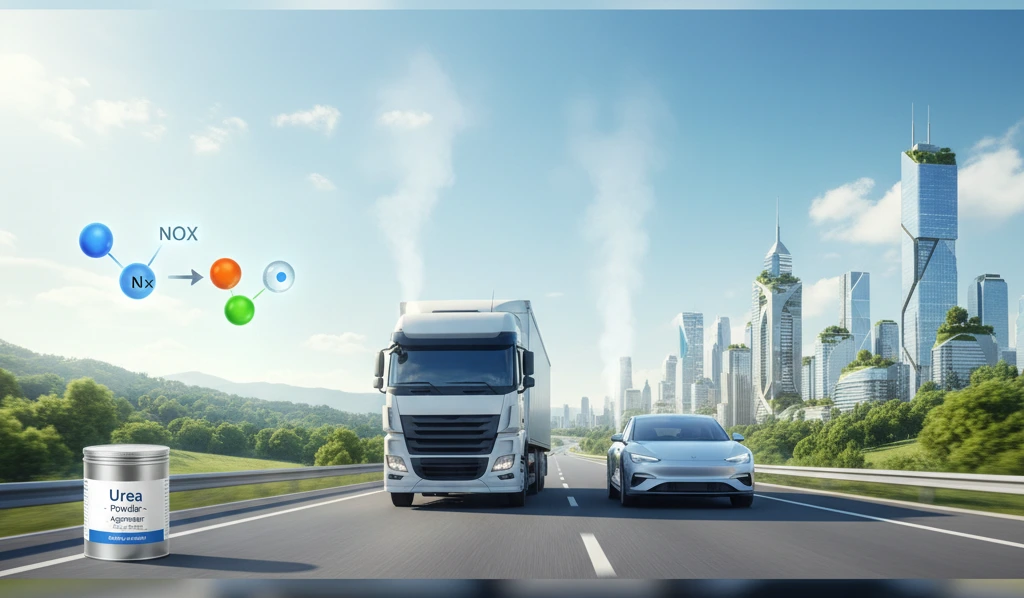
Urea reduces vehicle emissions by turning harmful nitrogen oxides (NOx) into harmless nitrogen and water. It does this as AdBlue, also called diesel exhaust fluid (DEF): a solution of 32.5% high-purity urea in deionised water. The fluid is sprayed into the exhaust of diesel vehicles fitted with selective catalytic reduction (SCR).
Most people know urea as a fertilizer, so it surprises them that the same compound helps modern trucks, buses and cars meet strict emission laws. The key difference is purity: the urea that goes into AdBlue has to be far cleaner than farm urea.
How SCR works, step by step
- The fluid is made. High-purity urea is dissolved in deionised water to exactly 32.5% urea.
- It is stored on board. Diesel vehicles with SCR have a separate AdBlue tank, usually with a blue filler cap.
- It is injected into the exhaust. A small dose is sprayed into the hot exhaust before the SCR catalyst.
- Urea turns into ammonia. The heat breaks the urea down into ammonia (NH3) and carbon dioxide.
- NOx is converted. On the catalyst, the ammonia reacts with nitrogen oxides to form nitrogen (N2) and water vapour.
SCR systems can remove most of the NOx from diesel exhaust, which is why they are used to meet standards such as Euro 6 and Euro VI, US EPA rules and India’s Bharat Stage VI.
Why AdBlue needs special urea
AdBlue must meet the international standard ISO 22241. Even small amounts of impurities, such as metals, phosphates or the by-product biuret, can poison the SCR catalyst or block the injector. So:
- Fertilizer urea is not suitable. It contains too much biuret and other impurities, and in India it is neem-coated.
- AdBlue is made from technical or automotive-grade urea with low biuret, low aldehydes and very low metal content.
- The water must be deionised.
| ISO 22241 parameter | Requirement |
|---|---|
| Urea content | 31.8 to 33.2% by mass (nominal 32.5%) |
| Biuret | 0.3% maximum |
| Aldehydes | 5 mg/kg maximum |
| Insoluble matter | 20 mg/kg maximum |
| Density at 20 °C | 1,087 to 1,093 kg/m³ |
| Freezing point | About −11 °C |
For the urea grades used to make DEF, see urea for AdBlue, DEF urea and technical grade urea.
Can urea reduce emissions in petrol cars?
No. AdBlue and SCR are used only on diesel engines. Petrol engines control NOx with a three-way catalytic converter instead.
Handling and storage
Urea is not flammable and has low toxicity, but AdBlue needs care:
- Store it between about −11 °C and 30 °C, out of direct sunlight.
- Use clean, dedicated containers. Never top up with tap water or reuse other containers.
- Dry urea for DEF production must be kept dry and sealed to prevent caking and contamination.
Other uses of urea
Beyond emissions control, urea is used as a nitrogen fertilizer, in resins and adhesives, in cosmetics and in the chemical industry. See what urea is used for and urea powder grades.
Buying urea for DEF production
Agromer trades urea, including technical grades, for industrial buyers and DEF producers. Send us the grade, the purity and biuret limits you need, the quantity, packaging and destination. Current market levels are covered in technical grade urea price.
Frequently asked questions
How does urea reduce emissions?
In an SCR system, AdBlue is injected into the hot exhaust. The urea breaks down into ammonia, which converts nitrogen oxides into nitrogen and water on the catalyst.
What is AdBlue made of?
32.5% high-purity urea dissolved in deionised water, meeting ISO 22241.
Can I use fertilizer urea to make AdBlue?
No. Fertilizer urea has too much biuret and other impurities, which can damage the SCR catalyst and injector.
Does urea work in petrol vehicles?
No. SCR with AdBlue is used only on diesel engines.
Is urea flammable?
No. Urea is not flammable and is stable under normal storage conditions.
What happens if AdBlue freezes?
It freezes at about −11 °C. Vehicles have heated tanks and lines, and the fluid works normally again once it thaws.