
If you work in agriculture, farming supplies, or fertilizer trading, you have probably heard about complex fertilizer many times. It is used by farmers and agricultural businesses to provide crops with important nutrients and support better growth.
But if you are buying complex fertilizer in large quantities, there are many things to understand before choosing a supplier. You need to know what complex fertilizer is, how it is made, what nutrients it contains, how much it costs, and how to check its quality.
This guide explains complex fertilizer in simple terms. It covers its composition, manufacturing process, uses, prices, quality, and bulk buying process. It is useful for farmers, fertilizer dealers, wholesalers, distributors, cooperatives, importers, and other agricultural businesses looking to buy complex fertilizer, from a single truckload to a full container shipment.
At Agromer, we operate as a complex fertilizer supplier, trader, and exporter, supporting farmers, distributors, and bulk buyers with reliable complex fertilizer solutions that meet both quality standards and market-driven pricing.
What Is Complex Fertilizer?
Complex fertilizer, also called complex fertiliser, is a type of fertilizer that gives crops two or more important nutrients in one granule. These nutrients are mainly nitrogen (N), phosphorus (P), and potassium (K).
The main difference between complex fertilizer and a simple fertilizer blend is how it is made. In a blended fertilizer, different fertilizer particles are mixed together in the same bag. In complex fertilizer, the nutrients are combined during the manufacturing process and formed into one uniform granule.
This means that each granule contains the same nutrient ratio. So, when a farmer spreads the fertilizer across a field, the nutrients are distributed more evenly. This makes nutrient application easier and more predictable.
For example, a 15-15-15 complex fertilizer contains nitrogen, phosphorus, and potassium in a balanced ratio. Every granule is made to contain these nutrients in the same proportion.
Complex fertilizer is also known as a multi-nutrient fertilizer because it provides more than one plant nutrient. It can also be called a complete fertilizer when it supplies all three major nutrients: nitrogen, phosphorus, and potassium.
Complex fertilizers are widely used in agriculture because many crops need more than one nutrient at the same time. They can be used during planting or at important stages of crop growth when plants need extra nutrition.
Compared with straight fertilizers, which normally provide only one main nutrient, complex fertilizer gives farmers a convenient way to supply several nutrients with a single product. It can also help provide a more even nutrient supply across the field when the right grade and application rate are used.
For farmers, fertilizer distributors, wholesalers, importers, and agricultural suppliers, complex fertilizer is an important product because it is available in different NPK grades for different crops, soils, and farming needs.
Complex Fertilizer Composition and Nutrition
The core of any complex fertilizer formula is built around three primary nutrients:
- Nitrogen fertilizer content — drives leafy, vegetative growth and supports photosynthesis
- Phosphorus fertilizer content — strengthens root systems, supports flowering, and aids energy transfer
- Potassium fertilizer content — improves stress tolerance, disease resistance, and fruit or grain quality
Beyond the primary three, many formulations are enriched with secondary nutrients and micronutrient fertilizer additions to address specific soil gaps. Common additions include:
- Sulfur fertilizer — important for protein synthesis and oil-seed crops
- Calcium fertilizer — supports cell wall strength and reduces disorders like blossom end rot
- Magnesium fertilizer — central to chlorophyll production
- Zinc fertilizer and boron fertilizer — micronutrients that, even in small amounts, can significantly affect yield in deficient soils
A good balanced fertilizer program usually starts with a soil test to confirm which of these secondary and micronutrients are actually needed before committing to a specific blend.
Many complex fertilizer grades also include secondary nutrients like sulfur, calcium, or magnesium, and micronutrients such as boron or zinc, depending on the crop and soil conditions they’re designed for.
Complex Fertilizer Examples
Some of the most widely traded and requested complex fertilizer grades worldwide include:
- NPK 10:26:26 — commonly used as a basal application for crops needing high phosphorus early in growth, such as wheat, paddy, maize, and pulses
- NPK 12:32:16 — another high-phosphorus grade suited to root development and early-stage plant vigor
- NPK 15:15:15 — a balanced, general-purpose grade suitable for a wide range of crops and soil types
- NPK 20:20:0 — a nitrogen-phosphorus combination without potassium, used where soil potassium levels are already sufficient
- DAP (Diammonium Phosphate) 18:46:0 — one of the most recognized complex fertilizers globally, valued for its high phosphorus content
- NPK 16:20:0 and NPK 20:20:0:13 — additional widely used combinations depending on regional soil and crop needs
The exact grade a buyer should choose depends on the crop being grown, the existing soil nutrient profile, and the growth stage the fertilizer is intended for. A proper soil test is always the best starting point before finalizing an order.
Types and Forms of Complex Fertilizer
Complex fertilizer isn’t a single physical product — it comes in several forms depending on how it will be applied and stored:
- Granular complex fertilizer — the most common form for broadcast or basal application in field crops
- Prilled complex fertilizer — small, rounded particles often used where uniform spreading is critical
- Water soluble complex fertilizer — designed to dissolve fully for use in fertigation or hydroponic systems
- Liquid complex fertilizer — applied through irrigation systems or as a foliar complex fertilizer spray for fast nutrient uptake
- Slow release complex fertilizer and controlled release complex fertilizer — engineered to release nutrients gradually over weeks, reducing the number of applications needed and cutting down on fertilizer leaching and nutrient runoff
Choosing between these forms usually comes down to the crop, the irrigation system available, and how much labor a farm or estate has for repeated applications.
Complex Fertilizer Uses and Application by Crop
Complex fertilizer application spans nearly every major crop category grown commercially. Some of the most common uses include:
- Complex fertilizer for rice — typically applied at transplanting and during tillering to support strong root establishment and grain filling
- Complex fertilizer for wheat — commonly used as a basal dose at sowing to support early root and shoot development
- Complex fertilizer for maize — supports the heavy nutrient demand of a fast-growing, high-yield crop
- Complex fertilizer for vegetables — balanced grades support both leafy growth and fruit development across a wide range of vegetable crops
- Complex fertilizer for fruits — supports flowering, fruit set, and improved fruit quality in orchard and plantation crops
- Complex fertilizer for sugarcane — supports the extended growing season and high biomass demands of the crop
- Complex fertilizer for cotton — supports root development early on and boll formation later in the season
For complex fertilizer for agriculture generally, the right grade and application rate depends on soil nutrient status, crop type, and the specific growth stage being targeted.
Benefits of Complex Fertilizer
The advantages of complex fertilizer over straight, single-nutrient products are one of the main reasons large-scale farms and commercial growers prefer it:
- Improved nutrient use efficiency — because nutrients are bonded within each granule, plants access a more consistent nutrient supply
- Better crop yield outcomes — balanced plant nutrition at the right growth stage supports stronger, more uniform yields
- Improved soil fertility management — combining nutrients in one application supports more consistent long-term soil nutrient uptake
- Reduced fertilizer leaching and nutrient runoff — particularly with slow release and controlled release forms, which limit the amount of nutrient lost to rainfall or irrigation water
- Lower labor and application costs — one pass covers multiple nutrients instead of applying straight fertilizers separately
How Complex Fertilizer Is Made
Complex fertilizer is made in a factory using a controlled chemical process. Unlike simple blended fertilizer, where different fertilizer materials are only mixed together, complex fertilizer is made so that the main nutrients are present together in each granule.
The main raw materials used to make complex fertilizer can include ammonia, phosphoric acid, and potassium salts. Other raw materials may also be added depending on the type and NPK grade of fertilizer being produced.
Step 1: Selecting the Raw Materials
The first step is choosing the right raw materials. Common materials include:
- Ammonia – provides nitrogen
- Phosphoric acid – provides phosphorus
- Potassium salts – provide potassium
- Other nutrients or materials may be added depending on the fertilizer formula
The materials are selected based on the required NPK ratio, such as 15-15-15, 16-16-16, or another grade.
Step 2: Mixing and Chemical Reaction
The raw materials are then brought together in the production system. Unlike a simple fertilizer blend, the materials go through a chemical reaction under controlled conditions.
The manufacturer carefully controls factors such as temperature, pressure, moisture, and the amount of each raw material. This helps produce fertilizer with the required nutrient content.
Step 3: Granulation
After the chemical reaction, the fertilizer material is sent to the granulation section of the fertilizer production plant.
Here, the material is formed into small, solid granules. The size and shape of the granules are controlled so they are suitable for handling, transportation, storage, and field application.
One of the main advantages of this process is that each granule can contain the required nutrients in a fixed ratio. For example, a properly produced NPK complex fertilizer can contain nitrogen, phosphorus, and potassium together in each granule.
Step 4: Drying and Cooling
The newly formed granules may contain extra moisture, so they are dried to reach the required moisture level. After drying, the granules are cooled.
Proper drying and cooling help improve the strength, storage life, and handling quality of the fertilizer.
Step 5: Screening
The fertilizer granules are then passed through screening equipment. This separates granules that are too small or too large from the required size.
The suitable granules continue to the next stage, while material outside the required size may be returned to the production process.
Step 6: Quality Testing
Before the fertilizer is packed, samples are tested to make sure the product meets the required specifications.
Depending on the product, manufacturers may check:
- Nitrogen content
- Phosphorus content
- Potassium content
- Moisture level
- Granule size
- Granule strength
- Nutrient ratio
- Physical appearance
Quality testing is especially important for bulk fertilizer suppliers, wholesalers, distributors, and international buyers who need a consistent product for large orders.
Step 7: Packaging and Bulk Supply
Once the complex fertilizer passes quality checks, it can be packed into different sizes. Common options include 25 kg bags, 50 kg bags, big bags, and bulk packaging.
For B2B buyers, complex fertilizer can also be supplied in large quantities for wholesale distribution, agricultural use, export, and commercial farming.
Complex Fertilizer vs Blended Fertilizer
The main difference is how the nutrients are combined.
With blended fertilizer, different fertilizer particles are mechanically mixed together. One particle may contain nitrogen, another may contain phosphorus, and another may contain potassium. During transport or application, these particles can sometimes separate because they have different sizes or densities.
With complex fertilizer, the production process is designed to put the required nutrients together in the same granule. This gives the product a more uniform nutrient distribution when it is properly manufactured and handled.
This is one reason complex fertilizers are widely used in commercial agriculture, fertilizer distribution, wholesale supply, and large farming operations.
Does Complex Fertilizer Dissolve Evenly?
A well-made complex fertilizer is designed to break down and release its nutrients in a predictable way when exposed to moisture in the soil. However, the actual speed of nutrient release depends on the fertilizer formulation, granule size, soil conditions, moisture, temperature, and other factors.
The important advantage is that the nutrients are contained within the same fertilizer granule rather than being supplied as completely separate fertilizer particles.
Complex Fertilizer Manufacturing Depends on the NPK Grade
There is no single formula for every complex fertilizer. The raw materials and production process can change depending on the NPK grade and the nutrients required.
For example, a manufacturer producing 15-15-15 complex fertilizer will use a different formulation from a manufacturer producing a fertilizer with a higher phosphorus or potassium content.
Some products may also include secondary nutrients or micronutrients, depending on the needs of the crop and the target market.
Why Manufacturing Quality Matters
For farmers and B2B fertilizer buyers, manufacturing quality is very important. A good complex fertilizer should have consistent nutrient content, suitable granule size, good physical strength, and proper moisture levels.
For importers, distributors, wholesalers, and agricultural suppliers, consistent quality is especially important because large quantities may be stored, transported, and sold to many different customers.
A reliable complex fertilizer manufacturer or bulk supplier should therefore be able to provide product specifications, quality information, packaging options, and consistent supply for large orders.
In Simple Words
The complex fertilizer manufacturing process can be explained in a simple way:
Raw materials → Chemical reaction → Granulation → Drying → Cooling → Screening → Quality testing → Packaging → Bulk supply
The main difference between complex and blended fertilizer is that complex fertilizer is produced through a controlled manufacturing process that puts the required nutrients together in the fertilizer granule. This makes it a useful choice for farmers, distributors, wholesalers, and other B2B fertilizer buyers who need a consistent product.
Complex Fertilizer Grades and Specifications
Below are some of the common complex fertilizer grades used in international trade, along with the usual nutrient ranges. Before placing a bulk order, buyers should check the exact specifications with the supplier. It is also important to ask for a Certificate of Analysis (COA) for each shipment. The COA confirms the actual nutrient content and helps make sure the fertilizer matches the agreed grade before the final payment is made.
| Specification | Typical Range |
|---|---|
| NPK Grade | Varies by product (e.g. 10:26:26, 15:15:15, 12:32:16, 18:46:0) |
| Nitrogen (N) content | 10% – 28% by weight |
| Available Phosphorus (P2O5) | 15% – 52% by weight |
| Water Soluble Phosphorus | Typically 70%–90% of total P2O5 |
| Potassium (K2O) content | 0% – 26% by weight |
| Moisture content | 1.5% max |
| Particle size | Minimum 90% retained between 1mm and 4mm |
| Physical form | Granular |
| Color | Typically grey, pink, or brown granules (varies by manufacturer and formulation) |
| Packaging | 25kg, 50kg bags, or bulk/jumbo bags on request |
| Shelf life | 24 months when stored in a dry, sealed environment |
Two of the most searched grades worldwide are 15-15-15 complex fertilizer and 16-16-16 complex fertilizer, both valued for their balanced, general-purpose nutrient ratio across a wide range of crops. 20-20-20 complex fertilizer, often supplied in water soluble form, is popular for fertigation and foliar programs where fast nutrient uptake matters.
Ready to Source Complex Fertilizer in Bulk?
Whether you’re a distributor building out your agri-input portfolio, an importer comparing supplier quotes, or a cooperative buying on behalf of farmers, working with an experienced commodity trading partner makes sourcing complex fertilizer far simpler — from confirming specifications and pricing to handling documentation and shipping logistics.
Get in touch for current complex fertilizer pricing, specifications, and export terms:
Address: 39 rue des Granges Galand, 37550 Saint Avertin, France
Phone: +33 (0)2 47 80 23 78
Email: pthary@agromer.org
Reach out with your target grade, packaging preference, and destination country, and we’ll get back to you with a full quote and documentation support for your complex fertilizer order.
How to Use Complex Fertilizer
- Basal application: Most complex fertilizer grades, especially high-phosphorus formulas, are applied at the time of sowing or transplanting to give the crop a strong root and early growth foundation.
- Top dressing: Certain balanced grades can also be applied during the growing season to support flowering, fruiting, or grain filling.
- Dosage: Application rate depends on crop type, soil test results, and target yield. Local agronomists or extension services can help calculate the right rate per hectare or acre.
- Storage: Keep bags off the ground, away from moisture, and in a dry, well-ventilated storage area to prevent caking and nutrient loss before use.
Complex Fertilizer vs Compound vs Blended vs Straight Fertilizer
Buyers new to sourcing often ask how these terms differ:
- Complex fertilizer vs compound fertilizer: These terms are frequently used interchangeably. Both describe fertilizers where nutrients are chemically combined into a single granule, rather than physically mixed.
- Complex fertilizer vs blended fertilizer: Blended fertilizer is a mechanical mix of separate straight-nutrient granules. It’s often cheaper to produce, but the nutrient distribution can be uneven if the mix separates during transport or handling. Complex fertilizer avoids this because every granule already contains the full nutrient blend.
- Compound fertilizer vs blended fertilizer: Same distinction as above — compound (complex) fertilizer is chemically uniform, while blended fertilizer relies on physical mixing of separate particles.
- Complex fertilizer vs straight fertilizer: A straight fertilizer, like urea or muriate of potash, supplies only one primary nutrient. Complex fertilizer supplies two or more, reducing the number of separate applications a farmer needs to make.
Complex Fertilizer Price and How Bulk Buying Works
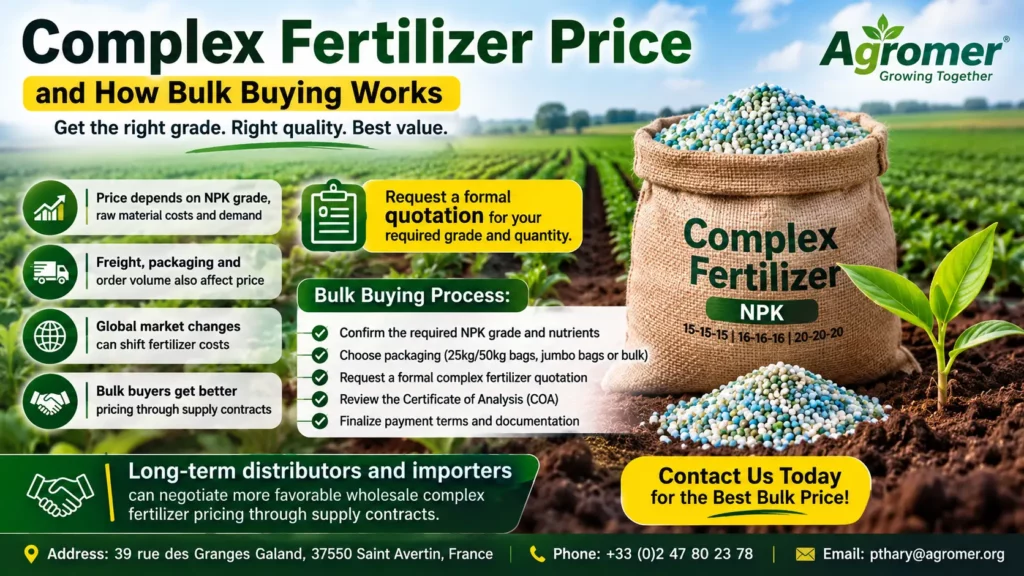
Complex fertilizer price per kg or per ton depends on the specific NPK grade, raw material costs (phosphate rock, ammonia, and potash prices all shift globally), packaging format, order volume, and shipping distance. The NPK grade is one of the main factors. For example, the price of a 15-15-15 fertilizer may be different from a 20-20-20 grade because they need different amounts of nutrients and raw materials.
The cost of raw materials also affects the price. Important materials such as phosphate rock, ammonia, and potash are traded in global markets, so their prices can go up or down. Freight and shipping costs, packaging, order size, and the final delivery location also have an effect on the wholesale complex fertilizer price.
Because fertilizer and shipping costs can change from season to season, there is no single fixed price that works for every buyer. If you are planning a complex fertilizer bulk order, it is better to request a current quotation based on your exact requirements.
How to Buy Complex Fertilizer in Bulk
The bulk buying process is usually simple. Buyers normally follow these steps:
- Choose the NPK grade
Tell the supplier which complex fertilizer grade you need, such as 15-15-15, 16-16-16, or another NPK formula. You can also specify any secondary nutrients or micronutrients you need. - Choose the packaging
Complex fertilizer can be supplied in 25 kg or 50 kg bags, jumbo bags, or in bulk. The right option depends on how you plan to store, transport, and sell the fertilizer. - Request a quotation
Ask the supplier for a formal complex fertilizer quotation. The quotation should include the fertilizer price, minimum order quantity, production time, shipping cost, and delivery terms such as FOB, CFR, or CIF. - Check product quality
Before placing a large order, review the Certificate of Analysis (COA) and product specifications. This helps confirm the NPK content, quality, and other agreed requirements. - Finalize payment and documents
Once the price and quality are agreed, the buyer and supplier can confirm payment terms and prepare the required export and shipping documents.
Bulk Orders Can Offer Better Prices
The bulk complex fertilizer price is often more attractive than buying small quantities. Importers, distributors, wholesalers, and large agricultural buyers may also get better pricing when they order regularly.
For example, a distributor that buys the same fertilizer throughout a farming season or commits to regular orders for a full year may be able to negotiate a better price than a buyer making only one small order.
For this reason, long-term supply contracts can be useful for fertilizer distributors and importers. They can help both the buyer and supplier plan production, shipping, and stock more easily.
Since the price of phosphate rock, ammonia, potash, fuel, and freight can change, buyers should not depend on old published prices. For an accurate complex fertilizer price per kg or per ton, it is best to contact a supplier directly and request a quotation based on the NPK grade, packaging, order quantity, and destination port.
Documentation Needed to Import Complex Fertilizer in Bulk
- Certificate of Analysis (COA) confirming nutrient content matches the agreed grade
- Certificate of Origin
- Packing list and commercial invoice
- Bill of Lading for sea freight
- Fumigation certificate, where required
- Import permit or local fertilizer registration, depending on the destination country’s regulations
Requirements differ from country to country, so it’s worth confirming with your supplier or a licensed customs broker ahead of shipment to avoid delays at port.
Frequently Asked Questions About Complex Fertilizer
What is complex fertilizer?
Complex fertilizer is a compound fertilizer in which two or more primary nutrients — nitrogen, phosphorus, and potassium — are chemically combined into a single, uniform granule, giving farmers a consistent nutrient ratio in every application.
How is complex fertilizer made?
It’s produced through a chemical reaction process involving raw materials like phosphoric acid, ammonia, and potassium salts, which are combined and then granulated to form uniform nutrient-rich particles.
How do I use complex fertilizer?
Most complex fertilizer is applied as a basal dose at sowing or transplanting, with certain balanced grades also suitable for top dressing during later growth stages. Application rate depends on soil test results, crop type, and target yield.
When should complex fertilizer be applied?
Timing depends on the crop and grade. High-phosphorus grades are usually applied at planting to support root development, while balanced grades may also be used during flowering or grain-filling stages.
What is the best complex fertilizer?
There’s no universal answer — the right grade depends on your soil nutrient levels and crop. High-phosphorus grades like 10:26:26 suit early root development, while balanced grades like 15-15-15 or 16-16-16 work well as general-purpose options across many crops.
What is the complex fertilizer application rate per acre?
Application rate varies by crop, soil fertility, and target yield, typically ranging from 50kg to over 150kg per acre depending on the grade and crop demand. A local agronomist or soil test result is the best way to calculate an exact rate.
What is the price of complex fertilizer per ton?
Price per ton depends on the NPK grade, current raw material costs, packaging, and shipping destination. Since these factors shift with global markets, it’s best to request a current quotation directly from a supplier.
What’s the difference between complex and compound fertilizer?
These terms are generally used interchangeably — both refer to fertilizers where nutrients are chemically bonded into a single granule rather than physically blended.
How do I buy complex fertilizer wholesale or in bulk?
Start by confirming your required NPK grade, packaging, and volume, then request a formal quotation covering pricing and shipping terms. From there, a certificate of analysis and other export documentation are arranged ahead of shipment.
What documents are needed to import complex fertilizer?
Typical documentation includes a certificate of analysis, certificate of origin, packing list, commercial invoice, bill of lading, and sometimes a fumigation certificate, along with any import permits required by the destination country.
Looking for a Complex Fertilizer Supplier or Bulk Manufacturer?
Whether you need an NPK complex fertilizer supplier for a one-time shipment or an ongoing partner as a complex fertilizer distributor or importer, working with an experienced commodity trading partner simplifies the entire process — from confirming specifications and pricing to arranging documentation and logistics for commercial agriculture at scale.
Get in touch for current pricing, specifications, and export terms:
Address: 39 rue des Granges Galand, 37550 Saint Avertin, France
Phone: +33 (0)2 47 80 23 78
Email: pthary@agromer.org
Send us your target grade, packaging preference, and destination country, and we’ll respond with a full quotation and documentation support for your complex fertilizer order.