
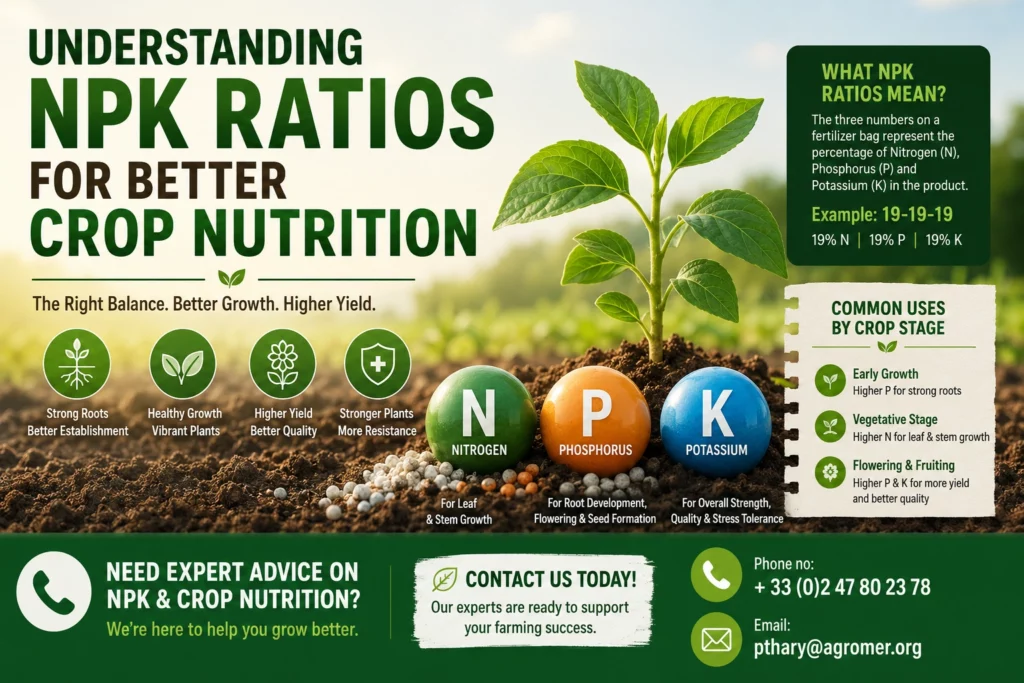
Learn what NPK ratios mean in fertilizers, how nitrogen, phosphorus, and potassium affect crop growth, and how to choose the right NPK fertilizer for better yield and soil health.
Healthy crops start with balanced nutrition. Farmers usually focus on seeds, irrigation, and pest control first, but fertilizer management decides how strong the crop actually grows. A weak nutrient plan can reduce yield even when everything else looks fine.
That’s where NPK ratios matter.
If you’ve ever looked at a fertilizer bag and seen numbers like 10-26-26, 19-19-19, or 46-0-0, those numbers tell you exactly what nutrients the fertilizer contains and how it will affect your crop growth.
A lot of farmers buy fertilizer based on local recommendations or dealer advice. Sometimes it works. Sometimes it causes excess leaf growth, weak roots, poor flowering, or low grain formation. Understanding NPK ratios helps you avoid that mistake.
Top & Best NPK Ratios Fertilizer Supplier, Dealer, Exporter & Manufacturer
Need help in sourcing best NPK ratios fertilizer as per your needs, then feel free to get touch with us.
Phone no: + 33 (0)2 47 80 23 78
Email: pthary@agromer.org
What does NPK mean?
NPK stands for:
- N = Nitrogen
- P = Phosphorus
- K = Potassium
These are the 3 primary nutrients every crop needs in large amounts.
Each nutrient has a different role inside the plant.
Nitrogen (N)
Nitrogen supports green leafy growth.
It helps crops produce chlorophyll, proteins, and healthy stems. Crops lacking nitrogen usually turn pale yellow and grow slowly.
Common signs of nitrogen deficiency:
- Yellow older leaves
- Thin stems
- Slow plant growth
- Low leaf development
Urea is one of the most common nitrogen fertilizers used in India.
Phosphorus (P)
Phosphorus supports root growth, flowering, and seed formation.
Young crops need phosphorus early because roots develop during the first growth stages. Crops with poor phosphorus supply often remain weak even after fertilizer application later.
Signs of phosphorus deficiency:
- Weak root system
- Delayed flowering
- Purplish leaves in some crops
- Low fruit or grain setting
DAP fertilizer contains a high phosphorus percentage, which is why many farmers use it during sowing.
Potassium (K)
Potassium improves overall plant strength.
It helps crops manage water balance, disease resistance, and fruit quality. Potassium also improves grain filling and shelf life in fruits and vegetables.
Signs of potassium deficiency:
- Brown leaf edges
- Weak stems
- Poor fruit quality
- Reduced drought tolerance
MOP (Muriate of Potash) is widely used to supply potassium.
Understanding fertilizer numbers
The 3 numbers printed on a fertilizer bag represent the percentage of N, P, and K inside the product.
Example:
19−19−19
This means:
- 19% Nitrogen
- 19% Phosphorus
- 19% Potassium
A balanced fertilizer like 19-19-19 works well during general vegetative growth because all 3 nutrients are present in equal amounts.
Now look at this:
10−26−26
This fertilizer contains:
- 10% Nitrogen
- 26% Phosphorus
- 26% Potassium
Farmers usually apply this during early crop stages or before flowering because phosphorus and potassium levels are much higher.
Why NPK ratios matter in farming
Every crop stage needs different nutrient levels.
A paddy crop during vegetative growth needs more nitrogen. A fruit crop during flowering needs higher phosphorus and potassium. Sugarcane requires heavy potassium support for strong cane development.
Using the wrong ratio at the wrong stage affects yield directly.
Too much nitrogen can create tall green plants with weak flowering. Excess phosphorus can block micronutrient uptake. Low potassium often reduces fruit quality and stress tolerance.
That’s why professional growers follow soil testing and stage-wise fertilizer schedules instead of random applications.
Common NPK ratios and their uses
20-20-20
20−20−20
A general-purpose balanced fertilizer.
Used in:
- Vegetables
- Garden plants
- Drip irrigation systems
- Foliar spray programs
Good for overall crop growth when no major nutrient deficiency exists.
10-26-26
Popular during root development and flowering stages.
Used in:
- Paddy
- Cotton
- Groundnut
- Pulses
Higher phosphorus supports strong early crop establishment.
12-32-16
12−32−16
Often applied during sowing.
Works well for:
- Wheat
- Maize
- Oilseeds
- Pulses
Farmers use it to support early root growth and initial crop vigor.
13-0-45
High potassium fertilizer.
Used in:
- Banana
- Tomato
- Chili
- Fruit crops
Supports fruit size, color, sweetness, and shelf life.
46-0-0
46−0−0
This is urea.
Very high nitrogen content. Mostly used during vegetative stages when crops require rapid leaf and stem growth.
Farmers usually split urea applications into multiple doses because excess nitrogen loss is common during rainfall or flooding.
Best NPK ratio for different crops
Different crops remove nutrients from the soil at different rates.
Rice (Paddy)
- Early stage: 10-26-26 or DAP
- Growth stage: Urea-based nitrogen application
- Grain filling: Potassium support improves grain quality
Wheat
- Basal dose: 12-32-16 or DAP
- Tillering stage: Nitrogen application
- Potassium improves grain weight
Vegetables
Vegetable crops need frequent nutrient supply because growth is fast.
Common choices:
- 19-19-19
- 20-20-20
- 13-0-45 during fruiting
Tomato and chili growers often increase potassium during flowering and fruit setting.
Fruit crops
Fruit plants need balanced nutrition across long growth cycles.
- Nitrogen during vegetative growth
- Phosphorus during root and flower development
- Potassium during fruit formation
Banana farmers usually use heavy potassium feeding because fruit weight depends heavily on potassium availability.
Soil testing matters more than guessing
A fertilizer ratio only works properly when the soil condition is known.
Some Indian soils already contain enough phosphorus because of repeated DAP usage over many years. Farmers still apply more phosphorus every season because they follow old fertilizer habits.
That increases cost without improving yield.
A proper soil test tells you:
- Existing nutrient levels
- Soil pH
- Organic carbon status
- Micronutrient deficiencies
- Fertilizer recommendation by crop
Even a basic soil test can reduce fertilizer waste significantly.
Difference between basal dose and top dressing
Farmers often hear these terms during fertilizer recommendations.
Basal dose
Applied before or during sowing.
Usually contains:
- Phosphorus
- Potassium
- Partial nitrogen
Purpose:
- Root establishment
- Early crop growth
Top dressing
Applied after crop establishment.
Mostly nitrogen-based fertilizers like urea are used because nitrogen demand increases during vegetative growth.
Split application improves nutrient use efficiency.
Water management affects NPK efficiency
Fertilizer performance depends heavily on irrigation.
Too much water can wash nitrogen away. Dry soil reduces phosphorus availability. Potassium uptake also drops during moisture stress.
That’s why fertigation systems became popular in vegetable and fruit farming. Nutrients dissolve in irrigation water and reach the root zone more efficiently.
Drip irrigation also reduces fertilizer loss compared to flood irrigation.
Organic matter improves nutrient absorption
Chemical fertilizer alone doesn’t maintain long-term soil health.
Farmyard manure, compost, vermicompost, neem cake, and crop residue improve:
- Soil structure
- Water retention
- Microbial activity
- Nutrient holding capacity
Farmers combining organic inputs with balanced NPK programs usually see better soil condition over time.
Common fertilizer mistakes farmers make
Applying excess urea
Very common in paddy farming.
Fields become dark green initially, but excessive nitrogen increases pest attack and lodging risk.
Ignoring potassium
Many farmers focus only on nitrogen and phosphorus because potassium fertilizers cost more.
This reduces fruit quality, shelf life, and stress resistance.
Single fertilizer dependency
Using only DAP or only urea every season creates nutrient imbalance in soil.
Balanced fertilization gives more stable results.
No soil testing
Blind fertilizer application increases cost and sometimes lowers productivity.
How to choose the right NPK ratio
Start with 3 things:
- Crop type
- Crop growth stage
- Soil nutrient status
Then choose fertilizer accordingly.
Young crops usually need root support. Flowering crops need phosphorus and potassium. Leafy vegetables need higher nitrogen during vegetative growth.
Local climate also matters. Heavy rainfall areas often lose nitrogen faster through leaching.
NPK ratios and micronutrients
NPK alone isn’t enough for complete crop nutrition.
Plants also need:
- Zinc
- Boron
- Sulfur
- Magnesium
- Iron
- Calcium
Many Indian soils now show zinc and sulfur deficiency because of continuous intensive farming.
That’s why modern fertilizer programs combine macronutrients and micronutrients together.
Final thoughts
Understanding NPK ratios gives farmers better control over crop nutrition, fertilizer cost, and yield quality. You don’t need advanced agricultural science to read fertilizer labels properly. Small improvements in nutrient planning can change crop performance noticeably over a full season.
Balanced fertilizer use, soil testing, proper irrigation, and stage-wise nutrient application usually produce better results than simply increasing fertilizer quantity.
And honestly, many yield problems start with nutrient imbalance long before farmers notice visible symptoms.
Contact Us Today
Choosing the right NPK fertilizer ratio can directly affect crop growth, soil health, flowering, fruit quality, and overall yield. If you are looking for a reliable supplier for bulk NPK fertilizers, Agromer provides consistent quality products for agricultural use across different crop stages and farming requirements.
We supply bulk quantities in MT for distributors, agricultural businesses, importers, and commercial farming operations. Whether you need balanced NPK fertilizers, high nitrogen grades, phosphorus-rich fertilizers, or potassium-based crop nutrition solutions, our team can help you choose the right formulation for your market and crop needs.
Our focus is simple: dependable supply, stable product quality, competitive pricing, and long-term business relationships.
Need bulk NPK fertilizer supplies for your agricultural business? Get in touch with our team today.
Phone: +33 (0)2 47 80 23 78
Email: pthary@agromer.org
Website: https://agromer.org/
Partner with Agromer for reliable bulk fertilizer supply, export support, and quality crop nutrition solutions trusted by agricultural businesses worldwide.