
Learn how to choose the best fertilizer for tomatoes, improve tomato plant growth, increase yields, and get healthier fruits with expert guidance feeding tips.
If you’ve ever planted tomatoes and ended up with yellow foliage, damaged fruit, or a plant that won’t blossom, the issue was most likely not with the seed, soil, or weather. Nine times out of ten, it boils down to fertilizer—either the incorrect type, the wrong timing, or just insufficient nutrients at the proper point in time.
Tomatoes are heavy producers. Tomato plants expect a lot from the soil, and if you don’t give it back to them in the proper manner at that given time, it will show in your yield. This guide will help you through everything you need to know about selecting the best fertilizer for tomatoes, including the specific nutrients tomato plants require, application schedules, what happens when growers skip proper fertilization, and how farmers, distributors, and importers can source fertilizer in bulk for commercial tomato production.
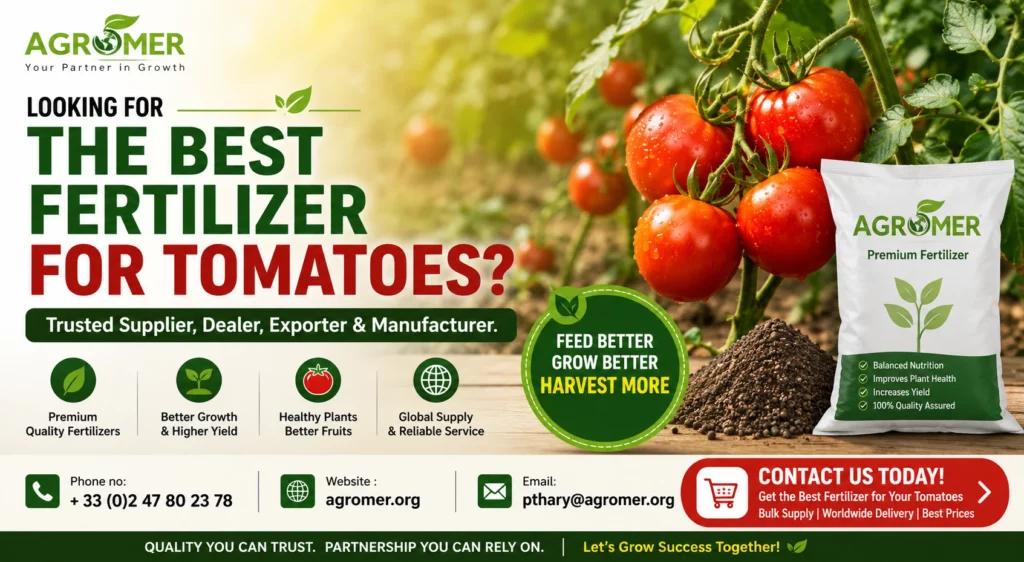
Looking for the Best Fertilizer for Tomatoes? Trusted Supplier, Dealer, Exporter & Manufacturer.
High-Quality Tomato Fertilizer for Better Growth, Higher Yield & Healthier Plants – Trusted Supplier & Exporter. Feel free to reach out to us.
Phone no: + 33 (0)2 47 80 23 78
Email: pthary@agromer.org
Why Tomato Plants Need Special Fertilizer Care
Tomatoes aren’t like leafy greens or herbs that mostly need nitrogen and call it a day. A tomato plant goes through several distinct growth stages — seedling, vegetative growth, flowering, fruit set, and fruit ripening — and each stage pulls different nutrients from the soil in different amounts.
Get the balance wrong and you’ll see it show up as:
- Lots of green leafy growth but few flowers (too much nitrogen)
- Blossom end rot on the fruit (calcium deficiency)
- Weak stems and poor root development (low phosphorus)
- Pale, curling leaves and small fruit (potassium shortage)
- Yellowing between leaf veins (magnesium or iron deficiency)
This is exactly why generic, one-size-fits-all fertilizers rarely deliver the yields serious tomato growers are looking for. Tomatoes need a formula built around their specific nutrient rhythm.
The Core Nutrients Every Tomato Fertilizer Needs
To grow great tomatoes, you need to give them the right fertilizer at the right time. This means providing tomato fertilizer with the nutrients for tomato plants at every stage they are growing. When you do this, it helps the tomato plants stay healthy, makes them produce flowers, and stops them from not having enough nutrients. It also helps the tomatoes get bigger, taste better, and last longer after you pick them.
Nitrogen (N)
Nitrogen promotes leafy, vegetative growth in the early stages. Tomato plants need a good amount of nitrogen in the first few weeks after transplanting, but too much later in the season encourages the plant to produce more leaves instead of fruit. Tomato plants need a good amount of nitrogen in the first few weeks after transplanting, but too much later in the season encourages the plant to produce more leaves instead of fruit.
Phosphorus (P)
Phosphorus is really important for plants. It helps them grow roots and makes flowers and fruit grow. When tomatoes are flowering they need a lot of phosphorus. So if you use a tomato fertilizer with a lot of phosphorus at this time you will get tomatoes. Phosphorus is the key, to getting a lot of fruit on your tomato plants.
Potassium (K)
Potassium is almost certainly the most essential nutrient for tomato fruit quality. It controls water transport throughout the plant, increases fruit size, increases sugar content, and boosts the plant’s immunity to bacterial infections. Most experienced tomato cultivators look for a fertilizer that has potassium comparable to or more than nitrogen.
Calcium
One of the most commonly seen and worsening tomato diseases is blossom end rot, which is caused directly by a calcium deficiency. Even when soil calcium levels appear to be normal on surface, uneven watering might prevent calcium uptake, thus a calcium-containing fertilizer serves as a layer of protection.
Magnesium
Magnesium forms the center of the chlorophyll molecule. Without enough of it, older leaves become yellow between the veins while the veins remain green, a typical indicator of magnesium deficiency in tomato harvests.
Micronutrients
Boron, zinc, iron, manganese, and copper are all required in small quantities, but a lack in any of them might mildly limit your output even if the major three (N-P-K) are properly balanced.
Tomato Feed for Plants
Tomato feed is a fertilizer that is specifically developed to give tomato plants with the nutrients they require for rapid development, healthy blooming, and high-quality fruit output. With all-purpose fertilizers, tomato feed provides the proper amounts of nitrogen (N), phosphorus (P), and potassium (K), as well as essential micronutrients that promote healthy roots, strong stems, and delicious tasting tomatoes.
Continuous feeding during the growth season improves plant health, increases fruit size, color, and overall production yields. Whether you produce tomatoes in gardens, greenhouses, outdoor spaces, or containers, using a high-quality tomato fertilizer guarantees that your plants get consistent nutrients from seedling to harvest.
Agromer provides high-quality tomato fertilizers to commercial farmers, wholesalers, and agricultural associations worldwide. Our high-grade nutrient solutions have been developed to boost production, increase crop quality, and promote environmentally friendly tomato food ffarming. Please contact us immediately to learn more about our bulk fertilizer options available for growing tomatoes.
What NPK Ratio Is Best for Tomatoes?
There isn’t a single magic number, because the ideal ratio changes with the growth stage:
- Early growth (transplanting stage): A balanced or slightly nitrogen-forward ratio, such as 10-10-10 or 5-10-5, to establish healthy roots and foliage.
- Flowering and fruit set: A phosphorus and potassium-forward ratio, such as 5-10-10 or 4-6-8, to push the plant toward blooming and setting fruit rather than just growing leaves.
- Fruiting and ripening: A potassium-rich formula, sometimes close to 3-4-6 or higher in potassium, to support fruit size, flavour, and ripening.
Water-soluble and slow-release granular fertilizers both work, but many commercial growers combine the two: a slow-release base application at planting, topped up with a water-soluble feed every couple of weeks through the season.
When to Fertilize Tomato Plants: A Practical Schedule
Timing matters just as much as the formula itself. Here’s a schedule that works well for both home gardeners and commercial tomato farms:
- At transplanting – Mix a balanced, phosphorus-rich starter fertilizer into the planting hole to encourage strong root establishment.
- 2–3 weeks after transplanting – Begin regular feeding once new growth appears, using a balanced or slightly nitrogen-forward formula.
- At first flowering – Switch to a phosphorus and potassium-heavy formula to support blossom development and fruit set.
- Throughout fruiting – Feed every 10–14 days with a potassium-rich fertilizer, keeping nitrogen moderate so the plant doesn’t put all its energy into leaves instead of fruit.
- Mid-to-late season – Watch for signs of calcium or magnesium deficiency and supplement with a foliar spray if needed, especially during hot, dry stretches when calcium uptake naturally slows down.
Overfeeding is just as damaging as underfeeding. Too much fertilizer, especially nitrogen, can burn roots, delay flowering, and make plants more attractive to pests. Always follow label rates and, where possible, base your program on an actual soil test rather than guesswork.
Step-by-Step: How to Apply Tomato Fertilizer Correctly
- Test your soil first. A basic soil test tells you your existing nutrient levels and pH. Tomatoes prefer a slightly acidic soil pH between 6.0 and 6.8.
- Choose the right form. Granular slow-release fertilizers are ideal for a steady base feed, while water-soluble fertilizers give you flexibility to adjust nutrients quickly as the plant’s needs change.
- Apply at the root zone, not on the foliage. For granular fertilizer, work it gently into the top few centimetres of soil around the base of the plant, then water thoroughly.
- Water immediately after fertilizing. This helps nutrients move down into the root zone where they’re actually usable, and reduces the risk of root burn.
- Avoid contact with stems. Keep fertilizer a few centimetres away from the main stem to prevent chemical burn.
- Use foliar feeding sparingly. Foliar sprays of calcium or magnesium can correct a deficiency quickly, but they should support, not replace, a proper root-zone feeding program.
- Adjust for weather. In hot weather, plants take up water and nutrients faster, so you may need to feed slightly more often; in cool or wet conditions, cut back to avoid nutrient runoff and waste.
What Happens If You Don’t Use the Right Tomato Fertilizer
This is the part many growers underestimate. Fertilizer isn’t a bonus extra — it’s the backbone of a productive tomato crop, and skipping it or using the wrong type has real, measurable consequences:
- Lower yield per plant. Nutrient-starved tomato plants simply produce fewer, smaller fruit.
- Blossom end rot. Calcium deficiency shows up as dark, sunken patches on the bottom of the fruit, making a large share of the harvest unsellable.
- Poor fruit quality. Low potassium levels lead to pale, less flavourful, thinner-walled fruit that doesn’t hold up well in transport or storage.
- Increased disease susceptibility. Nutrient-stressed plants have weaker cell walls and are more vulnerable to fungal and bacterial infections like early blight and fusarium wilt.
- Delayed harvest. Without adequate phosphorus and potassium at the flowering stage, fruit set is delayed, which can push your harvest window past the optimal market or export timing.
- Soil degradation over repeated seasons. Continuously farming tomatoes without replenishing key nutrients depletes the soil, making every future season harder and more expensive to manage.
- Reduced profitability for commercial farms. For farmers growing tomatoes at scale, all of the above translate directly into lost income — lower marketable yield, higher rejection rates from buyers, and higher long-term input costs to recover degraded soil.
In short, under-fertilizing or misusing fertilizer doesn’t just risk a disappointing home garden — for commercial operations, it can mean the difference between a profitable season and a loss-making one.
Best Fertilizers for Tomatoes Used Worldwide
The ideal choice depends on the plant’s growth stage, soil type, and whether you’re using organic or synthetic fertilizers. Below are some of the most trusted tomato fertilizers used by home gardeners, commercial growers, and professional farms around the world.
| Fertilizer | Best For | Type |
|---|---|---|
| NPK 10-10-10 | Balanced vegetative growth | Granular |
| NPK 5-10-10 | Flowering and fruiting | Granular |
| NPK 4-6-8 | Tomato production | Granular |
| NPK 8-32-16 | Root development and transplanting | Water-soluble |
| NPK 15-15-15 | General crop nutrition | Granular |
| NPK 12-12-17 + Magnesium | Commercial tomato farming | Granular |
| Calcium Nitrate | Preventing blossom end rot | Water-soluble |
| Potassium Nitrate (13-0-46) | Bigger fruits and better color | Water-soluble |
| Mono Potassium Phosphate (MKP 0-52-34) | Flowering and fruit set | Water-soluble |
| Sulphate of Potash (0-0-50) | Fruit quality and sweetness | Granular |
| Urea (46-0-0) | Nitrogen boost during early growth | Granular |
| Diammonium Phosphate (DAP 18-46-0) | Root establishment | Granular |
| Bone Meal | Root growth and flowering | Organic |
| Blood Meal | Nitrogen-rich leafy growth | Organic |
| Fish Bone Meal | Organic phosphorus source | Organic |
| Blood & Bone Fertilizer | Complete organic nutrition | Organic |
| Compost | Soil fertility improvement | Organic |
| Well-Rotted Manure | Long-term soil nutrition | Organic |
| Vermicompost | Healthy root zone and microbes | Organic |
| Seaweed Extract | Stress resistance and growth | Liquid |
| Fish Emulsion | Rapid organic nutrition | Liquid |
| Humic Acid | Improves nutrient uptake | Soil conditioner |
| Fulvic Acid | Enhances nutrient absorption | Biostimulant |
| Epsom Salt (Magnesium Sulfate) | Magnesium deficiency | Supplement |
| Gypsum | Adds calcium without raising pH | Soil amendment |
Best Fertilizer by Growth Stage
| Growth Stage | Recommended Fertilizer |
|---|---|
| Seedling | NPK 10-52-10 or 8-32-16 |
| Vegetative Growth | 10-10-10, 15-15-15, Fish Emulsion |
| Flowering | MKP (0-52-34), Bone Meal |
| Fruit Setting | 5-10-10, Potassium Nitrate |
| Fruiting | Sulphate of Potash, Calcium Nitrate |
| Harvest Period | High Potassium fertilizer with Calcium |
Leading Popular Tomato Fertilizer Brands: Manufacturers & Suppliers Worldwide
The following companies are among the world’s top fertilizer manufacturers, supplying fertilizers for tomato growing to commercial farms, greenhouse operations, and agricultural distributors. They provide highly specialized fertilizers, water-soluble NPK blends, calcium, potassium, micronutrients, and crop nutrition programs aimed at increasing tomato productivity and fruit quality.
| Company | Headquarters | Specialty | Production & Global Presence |
|---|---|---|---|
| Yara International | Oslo, Norway | NPK, Calcium Nitrate, Water-Soluble Fertilizers | One of the world’s leading crop nutrition companies with manufacturing plants and distribution in over 60 countries. A global leader in nitrate-based fertilizers and specialty crop nutrition. (Yara India) |
| Haifa Group | Haifa, Israel | Water-Soluble Fertilizers, Potassium Nitrate | Supplies specialty fertilizers to more than 100 countries and is widely recognized for greenhouse and horticultural crop nutrition. |
| ICL Group | Tel Aviv, Israel | Specialty Fertilizers, Controlled-Release Fertilizers | Global producer of specialty fertilizers and plant nutrition products with manufacturing and distribution across Europe, the Americas, and Asia. |
| Nutrien | Saskatoon, Canada | Potash, Nitrogen, Phosphate | One of the world’s largest fertilizer producers, capable of producing nearly 30 million tonnes of fertilizer annually with operations across North and South America, Australia, and Europe. (ONE MP) |
| The Mosaic Company | Tampa, Florida, USA | Phosphate & Potash Fertilizers | Fortune 500 company and one of the world’s largest producers of concentrated phosphate and potash, with production capacity of around 27 million tonnes annually. (Mosaic India) |
| COMPO EXPERT | Münster, Germany | Specialty Fertilizers & Biostimulants | Serves professional agriculture in more than 100 countries with premium fertilizers for fruits, vegetables, and greenhouse crops. |
| SQM | Santiago, Chile | Potassium Nitrate & Specialty Plant Nutrition | Global supplier of potassium nitrate, specialty fertilizers, and micronutrients widely used in tomato cultivation. |
| Coromandel International | Hyderabad, India | NPK, Specialty Fertilizers, Crop Protection | India’s largest private phosphatic fertilizer company with 16 manufacturing facilities and an annual fertilizer production capacity of approximately 4.5 million tonnes. (Coromandel) |
| FMC Corporation | Philadelphia, USA | Plant Nutrition & Crop Protection | Provides crop protection products and integrated crop management solutions for commercial agriculture worldwide. |
| UPL Limited | Mumbai, India | Crop Protection & Plant Nutrition | Operates in more than 130 countries, offering integrated crop nutrition, specialty fertilizers, and sustainable agricultural solutions. |
Agromer – Your Trusted Partner for Tomato Fertilizers
Agromer is a trusted supplier, dealer, exporter, and manufacturer of premium fertilizers for tomato cultivation. We provide high-quality plant nutrition solutions for commercial growers, distributors, importers, wholesalers, and agricultural businesses worldwide.
Our product range includes NPK fertilizers, organic fertilizers, blood & bone fertilizer, water-soluble fertilizers, micronutrients, and customized crop nutrition solutions to help growers achieve healthier plants, stronger root development, increased flowering, higher fruit set, and maximum tomato yields.
Whether you need fertilizers for open-field farming, greenhouse production, or large-scale commercial tomato cultivation, Agromer offers reliable quality, consistent supply, competitive pricing, and worldwide export support for bulk orders.
Please contact us right away to discuss your tomato plant fertilizer needs in further detail.
Phone no: + 33 (0)2 47 80 23 78
Email: pthary@agromer.org
Organic vs Synthetic Tomato Fertilizer
Both approaches can grow excellent tomatoes, and many growers use a combination of the two.
Organic options such as compost, well-rotted manure, bone meal, fish emulsion, and seaweed extract improve soil structure over time and release nutrients slowly, which suits gardeners looking for a long-term, low-risk approach.
Synthetic and blended fertilizers offer precise, fast-acting nutrient delivery, which is often preferred by commercial growers who need predictable results across large areas and tight harvest schedules.
For large-scale or export-oriented tomato farming, a well-formulated, quality-controlled blended fertilizer usually offers the most consistent and scalable results.
Sourcing Tomato Fertilizer in Bulk: A Guide for Farmers, Distributors, and Importers
If you’re farming tomatoes commercially, or you’re a distributor or importer sourcing fertilizer for resale, buying in bulk is where the real cost savings happen — but it also comes with a few extra considerations around quality consistency, packaging, logistics, and documentation.
What to Look for When Buying in Bulk
- Consistent nutrient composition batch to batch, backed by lab analysis
- Proper packaging suited to your shipping distance and climate (moisture-resistant bags, container-safe packaging for sea freight)
- Clear documentation for customs and import compliance
- A supplier who can scale with your order volume as your farm or client base grows
Bulk Pricing
Bulk fertilizer pricing depends on several factors: the formulation (granular vs water-soluble vs specialty blends), order volume, packaging requirements, destination country, and current raw material costs. Because of this, per-ton pricing for large or export orders is best confirmed with a current, customised quote rather than a fixed listed price, since input costs and freight rates shift regularly. As a general guide, bulk pricing typically becomes meaningfully more competitive at container-load volumes compared to smaller retail-pack orders — the larger the order, the lower your effective cost per kilogram or per ton.
How Export Orders Are Typically Handled
For international buyers, a typical export process looks like this:
- Inquiry and requirement discussion – Share your crop type, target region, order volume, and any specific certification requirements.
- Sample and formulation confirmation – Review product specifications and, where needed, request samples before committing to a full order.
- Quotation – Receive a formal quote covering product cost, packaging, and shipping terms (FOB, CIF, or other Incoterms as agreed).
- Order confirmation and production – Once terms are agreed, the order is scheduled for production or dispatch from existing stock.
- Documentation – Export documentation, including invoices, packing lists, and certificates of analysis, is prepared to meet the destination country’s import requirements.
- Shipping and logistics – Orders are dispatched via sea or land freight depending on destination and order size, with tracking shared through to delivery.
- After-sales support – Ongoing support for reordering, formulation questions, or agronomic guidance for the crop being grown.
Get in Touch for Bulk and Export Orders for fertilising tomato plants
Whether you’re a tomato farmer looking to place a season’s worth of fertilizer, a distributor wanting to stock a reliable tomato-specific formula, or an importer sourcing fertilizer for your region, Agromer works with farmers, distributors, and importers worldwide on both retail and bulk orders. Reach out with your crop details, target volume, and destination, and you’ll receive a tailored quote and formulation recommendation suited to your growing conditions.
Phone no: + 33 (0)2 47 80 23 78
Email: pthary@agromer.org
Frequently Asked Questions About Tomato Plant Fertilizer
1. What is the best fertilizer for tomatoes?
The best fertilizer for tomatoes is one that is specific to the plant’s growth stage — a balanced or phosphorus-forward formula at planting, followed by a potassium-rich formula during blooming and fruiting, with calcium and magnesium added to prevent frequent shortages of nutrients.
2. How often should I fertilize my tomato plants?
Once cultivated, feed every 10 to 14 days during the blooming and fruiting periods. Slow-release granular fertilizer products can be applied less regularly, usually once every 4 to 6 weeks.
3. What causes blossom end rot, and can fertilizer fix it?
Blossom end rot is caused by a calcium deficit, which is frequently caused by inconsistency in watering rather than a complete absence of calcium in soil. The most effective solution is to use a calcium-supplemented fertilizer or plant-based spray, as well as to water consistently.
4. Is too much nitrogen bad for tomato plants?
Yes. Too much nitrogen causes excessive green development at the cost of blooming and fruiting, slowing down ripening and reducing total yield.
5. Can I use the same fertilizer for the whole growing season?
It’s best to change your formula by stage, starting with nitrogen at planting and progressing to phosphorus and potassium as the plant blossoms and fruits. A single unchanged formula no longer delivers perfect results for the whole season.
6. What is the ideal soil pH for tomatoes?
Tomatoes grow best in a somewhat acidic soil, with a pH between 6.0 and 6.8. Even with the proper fertilizer amounts, nitrogen absorption becomes less effective when outside these parameters.
7. Do organic fertilizers work as well as synthetic ones for tomatoes?
Both can produce strong results. Organic fertilizers improve long-term soil health and release nutrients slowly, while synthetic and blended fertilizers offer faster, more precise nutrient control — many growers use a combination of both.
8. How can I buy tomato fertilizer in bulk for my farm or business?
Bulk buyers, distributors, and importers can contact us directly with their quantity, thier own specific formulation requirements, and destination to obtain a customized quote and exporting proposal.
9. Does fertilizer choice affect fruit taste and shelf life?
Yes. Potassium levels, in particular, have a major impact on fruit sugar content, firmness, and shelf life, making potassium-rich feeding throughout the fruiting stage important for both flavor and post-harvest quality.
10. What are the signs my tomato plant needs fertilizer right now?
Pale or yellowing leaves, poor growth, few or no blossoms, little fruit, and curling plant margins are all signs that your tomato plants want a nutrition boost.
Looking for a tomato food fertilizer formulation for your farm, or sourcing in bulk as a distributor or importer? Contact Agromer with your crop details, order volume, and destination for a customised quote and export plan.
Phone no: + 33 (0)2 47 80 23 78
Email: pthary@agromer.org