
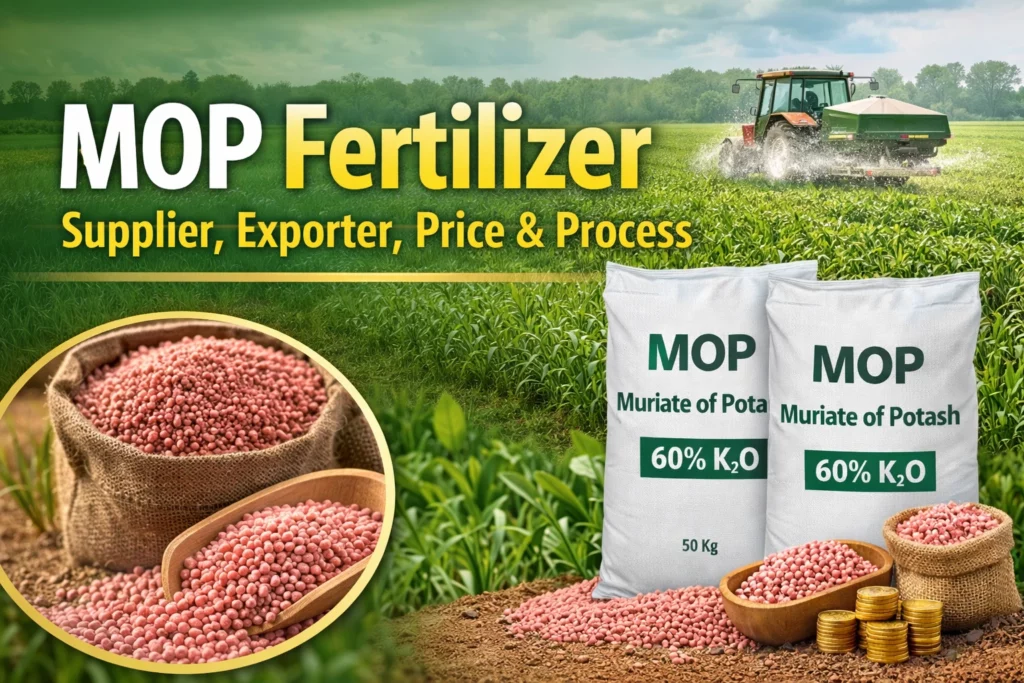
MOP stands for muriate of potash, the most widely used potassium fertilizer in the world. Chemically it is potassium chloride (KCl), and it carries about 60% potassium, shown as K2O. That gives it an NPK grade of 0-0-60.
Ask a farmer, a trader or a fertilizer importer what they use for potassium and most will say MOP. Some call it potash, some say muriate of potash, some say 60% K2O. It is all the same product. This guide explains what it does, how to use it, and what to check if you buy it in bulk.
MOP at a glance
| Item | Detail |
|---|---|
| Full name | Muriate of potash (“muriate” is an old word for chloride) |
| Chemical name | Potassium chloride (KCl) |
| NPK grade | 0-0-60 |
| Potassium content | About 60% K2O |
| Colour | Red/pink or white, depending on the source |
| Forms | Standard (fine) and granular |
| Main job | Supplies potassium for strength, quality and stress tolerance |
Why crops need potassium
Potassium is one of the three main plant nutrients, next to nitrogen and phosphorus. Nitrogen grows leaves. Phosphorus builds roots. Potassium is what keeps the plant strong and the harvest good.
It helps plants:
- Stand up to drought and heat by controlling water loss
- Resist disease
- Build stronger stems, so crops fall over less
- Fill out fruit and grain, with better size, colour and shelf life
Crops that respond well to MOP include rice, wheat, maize, sugarcane, bananas, cotton and many vegetables. For one example, see our guide to sugarcane fertilizer.
How to apply MOP
MOP goes on the soil, not on the leaves. Most farmers apply it:
- Before sowing or during soil preparation
- As part of the basal dose, often mixed with other fertilizers
- In two splits on long-season crops, if the soil test calls for it
Potassium moves slowly in most soils, so early application works best. Your rate should come from a soil test. As a quick conversion, 100 kg of MOP supplies about 60 kg of K2O.
MOP vs. SOP vs. DAP
| MOP | SOP | DAP | |
|---|---|---|---|
| Main nutrient | Potassium | Potassium plus sulphur | Phosphorus plus nitrogen |
| Grade | 0-0-60 | About 0-0-50 | 18-46-0 |
| Cost | Lowest-cost potassium | Higher than MOP | Different nutrient, not a substitute |
| Best for | Most field crops | Chloride-sensitive crops such as tobacco, some fruit and potatoes | Root growth at sowing |
Read more in the top 3 fertilizers and potash vs potassium.
What does MOP cost?
There is no fixed price. MOP follows the world potash market, and your price also depends on freight, import duty, packaging and the season. Here is how the World Bank benchmark for granular potassium chloride has moved:
| Period | Price, $ per tonne |
|---|---|
| 2024 average | 295.1 |
| 2025 average | 347.5 |
| April to June 2026 | 402.9 |
| July to September 2026 | 383.6 |
| September 2026 | 367.5 |
For bag prices and K2O questions, see our K2O fertilizer price guide.
Is MOP safe to use?
Yes, at the right rate. Problems come from overuse:
- Too much chloride can harm sensitive crops. Use SOP for those.
- Heavy, repeated use can raise soil salinity.
- Excess potassium can block calcium and magnesium uptake.
A soil test is the simplest way to avoid all three.
Signs your crop needs potassium
- Yellow or brown scorching along leaf edges, starting on older leaves
- Weak stems and lodging
- Small or poorly coloured fruit
- More disease than usual
Buying MOP in bulk
Agromer supplies MOP to importers, distributors and traders. A clear enquiry gets you a faster, more accurate offer. Include:
- Grade (standard or granular) and colour (red or white)
- Quantity and shipment schedule
- Packaging: bulk, big bags or 50 kg bags
- Destination port and delivery terms, such as FOB or CIF
Standard shipping documents include a commercial invoice, packing list, certificate of origin, bill of lading and a quality certificate. Independent inspection at loading is recommended. See our guide on how to assess fertilizer suppliers and our bulk fertilizer range.
Frequently asked questions
What is MOP fertilizer?
MOP is muriate of potash, or potassium chloride (KCl). It is the most common potassium fertilizer and contains about 60% K2O.
What is the NPK ratio of MOP?
0-0-60. It contains no nitrogen or phosphorus, and about 60% potassium as K2O.
What is the difference between DAP and MOP?
DAP supplies phosphorus and nitrogen (18-46-0). MOP supplies only potassium (0-0-60). They do different jobs and are often used together.
Which is better, MOP or SOP?
MOP is cheaper and suits most crops. SOP costs more but is better for chloride-sensitive crops such as tobacco and some fruit.
What are the disadvantages of MOP?
Its chloride can harm sensitive crops, and heavy use can raise soil salinity. Applying it at the rate your soil test suggests avoids most problems.
Which crops benefit most from MOP?
Rice, wheat, maize, sugarcane, bananas, cotton and many vegetables respond well, especially on soils low in potassium.