
Potash is a potassium fertilizer. The name covers mined and manufactured salts that contain potassium in a water-soluble form, and in farming it usually means potassium chloride (KCl), known as muriate of potash (MOP). Potassium is the “K” in NPK, one of the three main plant nutrients alongside nitrogen and phosphorus.
The word comes from “pot ash”: early producers soaked wood ashes and boiled the solution in iron pots to make potassium carbonate. Today almost all potash is mined from underground deposits.
Quick answers
- What is potash?
- A potassium fertilizer. In farming it usually means muriate of potash (MOP), which is potassium chloride (KCl) with about 60% K2O.
- MOP full form
- Muriate of Potash.
- What is potash used for?
- Mainly as fertilizer: about 85% of US potash sales go to agriculture (USGS). The rest is used in chemicals and industry.
- What does K2O mean?
- The standard way potassium content is stated on fertilizer labels. 1 kg of K2O equals about 0.83 kg of potassium (K).
- How is potash made?
- Mostly mined from underground salt deposits, or recovered from brines by solar evaporation, then purified.
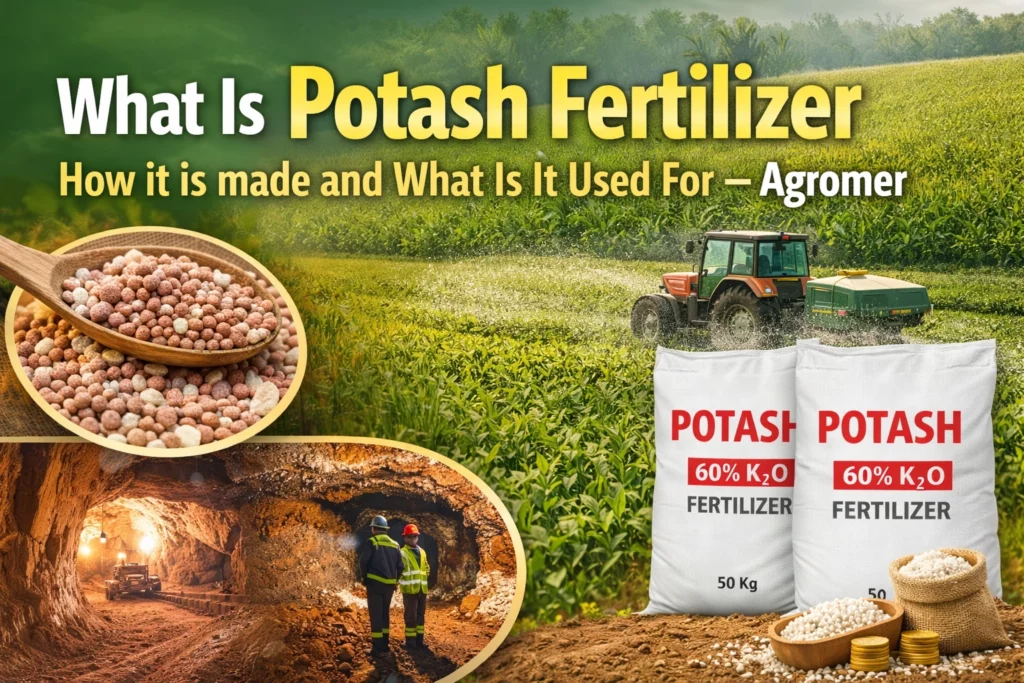
Potash at a glance
| Item | Detail |
|---|---|
| What it is | Potassium fertilizer, mostly potassium chloride (KCl) |
| MOP full form | Muriate of Potash (muriate = chloride) |
| Potassium content | MOP about 60% K2O; SOP about 50% K2O |
| Main use | Fertilizer (about 85% of US potash sales) |
| World production, 2024 | About 48 million tonnes K2O, led by Canada, Russia, Belarus and China |
| Price, September 2026 | $367.50 per tonne (World Bank, granular KCl, CFR Brazil) |
Potash vs. potassium: are they the same?
Not quite. Potassium (K) is the chemical element and the nutrient plants need. Potash is the fertilizer that delivers it. Labels show potassium as K2O (potassium oxide): a bag of MOP labelled 0-0-60 contains the equivalent of 60% K2O, or about 50% elemental potassium. Read more in potash vs potassium and K2O fertilizer prices.
Types of potash fertilizer
| Type | Formula | K2O content | Best for |
|---|---|---|---|
| Muriate of potash (MOP) | KCl | About 60% | Most field crops; the cheapest source of potassium |
| Sulphate of potash (SOP) | K2SO4 | About 50%, plus sulphur | Chloride-sensitive crops: fruit, vegetables, tobacco, potatoes |
| Potassium nitrate (NOP) | KNO3 | About 46%, plus 13% N | Fertigation, greenhouses and foliar feeding |
What is potash used for?
Most potash is used as fertilizer, on its own or in NPK blends: in the United States the fertilizer industry takes about 85% of potash sales. The rest is used to make glass, soaps and detergents, water softeners, de-icers and potassium hydroxide for the chemical industry.
What does potassium do for plants?
- Regulates water use by opening and closing leaf pores (stomata), helping plants cope with drought and heat
- Moves sugars and nutrients through the plant, improving fruit size, colour and taste
- Strengthens stems and roots, so crops lodge less
- Improves resistance to disease, frost and stress
- Helps crops use nitrogen efficiently, so it works best alongside nitrogen fertilizers such as urea
How is potash made?
Potash comes from layers of potassium-rich salt left behind when ancient seas evaporated. The main ore mineral is sylvinite, a mix of potassium chloride and rock salt.
- Mining: ore is extracted by conventional underground mining or by solution mining, in which hot water dissolves the ore and the brine is pumped to the surface.
- Separation: potassium chloride is separated from rock salt and clay by froth flotation or by dissolving and crystallising it.
- Finishing: the product is dried, screened into standard or granular grades, and sometimes compacted into larger granules for blending.
World potash production reached about 48 million tonnes (K2O equivalent) in 2024. Canada, which also holds the largest reserves, is by far the biggest producer and exporter:
| Country | 2024 production (thousand tonnes K2O) | 2023 production |
|---|---|---|
| Canada | 15,000 | 13,500 |
| Russia | 9,000 | 9,000 |
| Belarus | 7,000 | 4,500 |
| China | 6,300 | 6,000 |
| Germany | 3,000 | 2,700 |
| Israel | 2,400 | 2,330 |
| Jordan | 1,800 | 1,700 |
| Laos | 1,500 | 1,500 |
Potash prices in 2026
Potash has been steadier than nitrogen fertilizers this year. According to the World Bank, granular potassium chloride (CFR Brazil) averaged:
| Period | Potassium chloride, $ per tonne |
|---|---|
| 2024 average | 295.1 |
| 2025 average | 347.5 |
| April to June 2026 | 402.9 |
| July to September 2026 | 383.6 |
| September 2026 | 367.5 |
For bag prices and India MRP questions, see K2O fertilizer price.
Crops that benefit most from potash
Potassium-hungry crops include potatoes, bananas, sugarcane, tomatoes and other vegetables, fruit trees, cotton, maize, rice and wheat. Chloride-sensitive crops such as tobacco, some fruit and potatoes grown for quality often do better with SOP than MOP. See sugarcane fertilizer for one example.
Recommended K2O dosage per acre
| Crop | Recommended K2O (kg/acre) |
|---|---|
| Rice | 20–40 |
| Wheat | 20–30 |
| Potato | 40–60 |
| Tomato | 35–50 |
| Cotton | 40–50 |
| Sugarcane | 50–70 |
Apply potash before planting or early in the season, since it moves slowly in the soil. Many farmers split it: half at sowing and half during early growth. For a quick correction under stress, a foliar spray of 1 to 2 grams of potassium fertilizer per litre of water can be used.
Signs of potash deficiency
- Yellow or brown scorching along leaf edges, starting on older leaves
- Weak stems and lodging
- Small, poorly coloured or poor-tasting fruit
- Lower yields and more disease
Too much potash is also a problem: excess potassium can block calcium and magnesium uptake. Balanced use based on a soil test is the safest approach.
Buying potash in bulk
Agromer supplies potash and other fertilizers in bulk to importers and distributors. For an offer, send the type (MOP or SOP), grade (standard or granular), quantity, packaging and destination port. See our bulk fertilizer supply page.
Frequently asked questions
What is potash?
Potash is the common name for mined and manufactured salts that contain potassium in a water-soluble form. In farming it usually means potassium chloride (muriate of potash, MOP), the most widely used potassium fertilizer.
What is the full form of MOP?
MOP stands for Muriate of Potash. “Muriate” is an old name for chloride, so MOP is potassium chloride (KCl). It contains about 60% K2O.
Are potash and potassium the same?
No. Potassium (K) is the chemical element and plant nutrient. Potash is the fertilizer that supplies it, most often potassium chloride. Fertilizer labels express potassium content as K2O.
What is potash used for?
Most potash is used as fertilizer, supplying the K in NPK; in the United States the fertilizer industry takes about 85% of potash sales, according to USGS. The rest goes into industrial products such as glass, soaps, detergents, water softeners and potassium hydroxide.
How is potash made?
Potash ore is mined from ancient underground salt deposits, either by conventional mining or by solution mining, where water dissolves the ore and brine is pumped to the surface. The potassium chloride is then separated from rock salt by flotation or crystallisation, dried and screened.
What is the price of potash in 2026?
The World Bank benchmark for granular potassium chloride (CFR Brazil) averaged $367.50 per tonne in September 2026, compared with an average of $347.50 per tonne in 2025.
What are signs of potash deficiency?
Yellow or brown scorching along leaf edges, starting on older leaves, weak stems that lodge easily, small or poor-quality fruit and lower yields.