
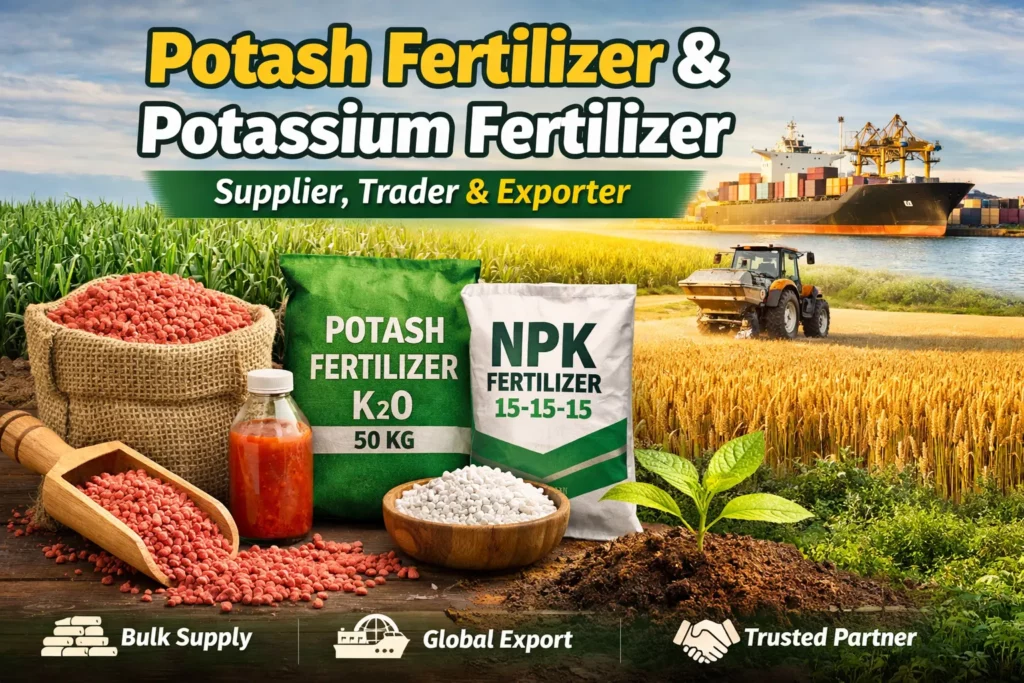
When people talk about fertilizers, most of the time they think only about urea or DAP. But in real farming, crops do not grow strong with nitrogen alone. One of the most important nutrients for plants is potassium, and this is where potash fertilizer becomes very important.
At Agromer, we work as a potash fertilizer supplier, trader, and exporter, helping farmers, distributors, and bulk buyers get the right fertilizer at the right quality and price. If you have any queries related to potash vs potassium so please get in touch with us.
Buy Bulk Potash Fertilizer & Potassium Fertilizer from Trusted Supplier & Manufacturers
Looking for a dependable supplier of high-purity potash (potassium) fertilizers at competitive wholesale rates?
We are a globally established manufacturer, supplier, trader, and distributor, serving large-scale agricultural and industrial buyers across international markets.
Our potassium fertilizers are manufactured and delivered under rigorous quality assurance and process control systems, ensuring uniform nutrient content, excellent solubility, and reliable field performance for commercial agriculture and agri-input formulations.
📧 Email: pthary@agromer.org
📞 Call / WhatsApp: +33 (0)2 47 80 23 78
Get in touch today for bulk supply contracts, technical data sheets, pricing details, and customized potassium fertilizer solutions aligned with your specific market and application requirements.
What Is Potash Fertilizer?
Potash fertilizer is a fertilizer that mainly supplies potassium (K) to plants. Potassium helps plants grow strong, improves root development, supports flowering, and helps crops fight stress like heat, pests, and diseases.
Many people ask if potash fertilizer and potassium fertilizer are the same. In simple words, yes, potash fertilizer is a common source of potassium fertilizer used in agriculture.
Potash is usually available in forms like:
- MOP (Muriate of Potash)
- SOP (Sulphate of Potash)
- Liquid potash fertilizer
Each type is used based on crop need, soil condition, and climate.
Learn in detail what potash fertilizer is, how it is made, and what it is used for in agriculture. Simple guide on potassium benefits for soil, crops, and plant growth by Agromer.
Why Potassium Is Important for Crops
Potassium plays a big role in plant health. Without enough potassium, plants may look weak even if you use nitrogen and phosphorus.
Potassium helps in:
- Strong stem growth
- Better water control in plants
- Improved fruit size and color
- Higher crop yield
- Better resistance to disease
That is why potash fertilizer is often added along with nitrogen and phosphorus in NPK fertilizer programs. You can read more about balanced nutrients on this page about NPK fertilizer.
Potash Fertilizer Uses in Agriculture
Potash fertilizer uses are wide and apply to many crops. Farmers use it for:
- Rice and wheat
- Sugarcane
- Cotton
- Fruits and vegetables
- Tobacco
- Flowers and plantation crops
For crops like sugarcane, potassium helps improve juice quality and stalk strength. You can also check this guide on sugarcane fertilizer to understand crop-specific needs.
Potash fertilizer is also useful for flowering plants, as it helps improve bloom size and color.
Potash Fertilizer Formula Explained Simply
The potash fertilizer formula mainly focuses on potassium content. For example:
- MOP fertilizer usually contains around 60% K₂O
- SOP contains around 50% K₂O
When people talk about NPK values, potassium is shown as the third number. For example, in a 10-10-20 fertilizer, potassium is higher than nitrogen and phosphorus.
Understanding fertilizer formulas helps farmers avoid overuse and save cost.
Potash Fertilizer NPK and Balanced Nutrition
Potash fertilizer is rarely used alone. It works best when combined with nitrogen and phosphorus.
This is why many farmers prefer NPK combinations. Nitrogen supports leafy growth, phosphorus supports roots, and potassium strengthens the plant.
You can learn more about different nutrient combinations from this guide on types of fertilizers and also see what are the top 3 fertilizers commonly used worldwide.
Potash Fertilizer Liquid vs Granular
Potash fertilizer is available in both granular and liquid forms.
- Granular potash fertilizer is mostly used for soil application.
- Potash fertilizer liquid is used for drip irrigation or foliar spray.
Liquid potash works faster but is usually costlier. Granular potash fertilizer is easier to store and transport, especially in bulk.
Similar comparisons are made for nitrogen fertilizers too, like in this article about liquid vs granular urea fertilizer.
Potash Fertilizer 50 kg Bag – What Buyers Usually Ask
Many farmers and dealers ask for potash fertilizer 50 kg packing because it is easy to handle and transport.
Common questions include:
- What is the potash fertilizer 50 kg price?
- What is the potash fertilizer price per kg?
- What is the potash fertilizer price 50kg today?
Prices depend on:
- Type of potash (MOP or SOP)
- Market demand
- Import cost
- Transport and storage
Because prices change often, bulk buyers usually contact suppliers directly instead of relying on old online rates.
If you are buying in bulk, you can explore options on buy fertilizer bulk supplier manufacturer.
Potash Fertilizer Price – What Affects It?
Potash fertilizer price is not fixed. It changes based on many factors.
Main factors include:
- Global potash supply
- Import and export policies
- Currency rates
- Shipping costs
- Seasonal demand
That is why potash fertilizer price per kg today may be different next month. For large buyers, exporters, and distributors, working with a trusted trader helps manage price risk.
Also read the diffrence between potash and potassium or are they same.
Can You Mix Potash Fertilizer With Urea?
Yes, potash can be mixed with urea in many cases. Urea provides nitrogen, and potash provides potassium.
Before mixing, it is important to:
- Check soil test results
- Follow crop recommendation
- Avoid excess application
You can learn more about nitrogen fertilizer basics from what is urea used for and how to use urea as fertilizer.
Signs of Potassium Deficiency in Plants
Many farmers do not realize potassium deficiency early.
Common signs include:
- Yellow or brown edges on leaves
- Weak stems
- Poor fruit quality
- Slow growth
- Low resistance to pests
These are clear signs that potash fertilizer is needed.
Is Too Much Potash Bad for Plants?
Yes, too much potash fertilizer can also cause problems.
Overuse may lead to:
- Imbalance of nutrients
- Reduced uptake of magnesium and calcium
- Soil salinity issues
That is why balanced fertilization is always better than heavy use of one nutrient.
Organic vs Chemical Potash Fertilizer
Some buyers ask whether organic potash is better than chemical potash.
Both have their place. Organic fertilizers improve soil health, while chemical fertilizers give faster results.
You can read a detailed comparison here: organic vs chemical fertilizers.
Who Is the Largest Producer of Potash?
Globally, countries like Canada, Russia, and Belarus are major potash producers. India imports a large quantity to meet agricultural demand.
This makes reliable traders and exporters important for smooth supply.
Why Choose Agromer as Your Potash Fertilizer Supplier?
Agromer is not just a seller. We work as a supplier, trader, and exporter, focusing on long-term business.
Why buyers choose Agromer:
- Reliable bulk supply
- Export-ready packaging
- Clear product specifications
- Support for international buyers
- Competitive pricing
We also deal in multiple fertilizer categories, not just potash. Buyers can explore options like best fertilizer for agriculture and best fertilizer for plants.
How To Buy Bulk High-Purity Potash (Potassium) Fertilizers From Suppliers
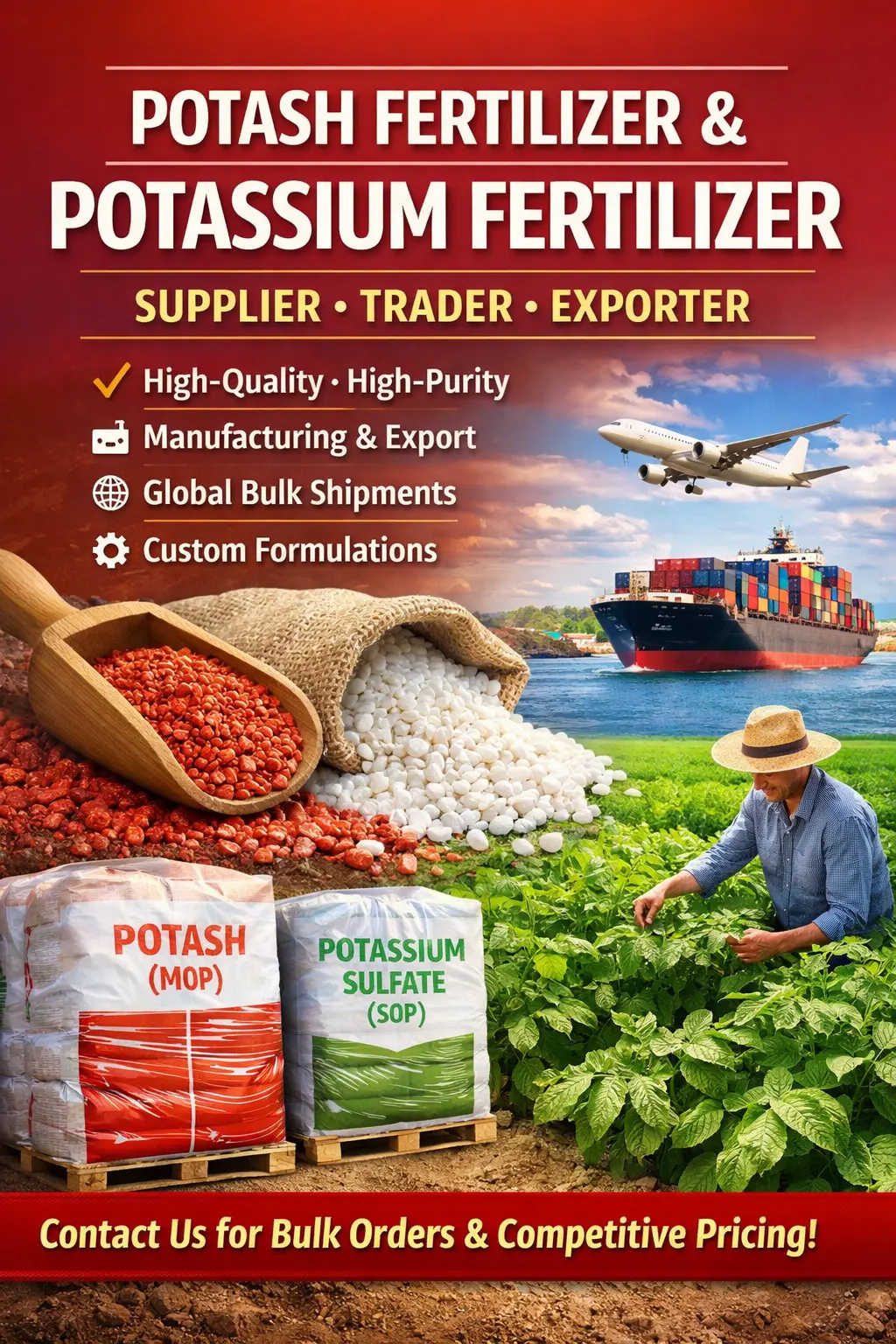
Buying bulk high-purity potash (potassium) fertilizers requires a structured, technical approach to ensure quality, compliance, and price efficiency. Below is a step-by-step buyer’s guide used by professional importers, distributors, and large farms.
1. Define Your Technical Requirements
Before contacting suppliers, clearly specify:
- Product type
- MOP (Potassium Chloride – KCl)
- SOP (Potassium Sulfate – K₂SO₄)
- Potassium Nitrate (KNO₃)
- Purity & grade
- K₂O content (e.g., 60%, 62%)
- Agricultural / industrial / water-soluble grade
- Physical form
- Granular, crystalline, powder
- Application
- Soil application, fertigation, blending, or industrial use
Having clear specs avoids low-grade substitutions.
2. Shortlist Verified Bulk Suppliers
Look for suppliers who are:
- Manufacturers or direct exporters (not brokers only)
- Experienced in international bulk shipments
- Able to provide consistent supply volumes
Check:
- Company registration & export license
- Years in operation
- Countries previously supplied
- Client references (if available)
3. Request Mandatory Documents
A legitimate bulk potash supplier should provide:
- Technical Data Sheet (TDS)
- Certificate of Analysis (COA)
- Material Safety Data Sheet (MSDS)
- Product origin details
- Quality standards (ISO, REACH, SGS, Intertek, etc.)
⚠️ Never place bulk orders without a COA and TDS.
4. Compare Bulk Pricing Correctly
Ask for quotes based on:
- FOB / CIF / CFR pricing
- Minimum Order Quantity (MOQ)
- Packaging (50 kg bags, jumbo bags, bulk vessel)
- Delivery port & lead time
Avoid choosing the cheapest offer blindly—quality inconsistency costs more long-term.
5. Verify Quality & Consistency
For large volumes:
- Request pre-shipment inspection
- Use third-party testing agencies (SGS, Bureau Veritas)
- Ask for sample analysis before final confirmation
This step prevents nutrient variation and contamination risks.
6. Negotiate Supply Terms
Professional suppliers will offer:
- Long-term contracts
- Volume-based discounts
- Customized formulations (if required)
- Stable supply schedules
Clarify:
- Payment terms (LC, TT, DP)
- Delivery timeline
- Claims & dispute process
7. Arrange Logistics & Compliance
Ensure:
- Proper HS code classification
- Import permits (country-specific)
- Phytosanitary or fertilizer registration (if required)
- Correct labeling and documentation
Work with suppliers familiar with your import regulations.
8. Build Long-Term Supplier Relationships
Reliable potash buyers focus on:
- Consistent quality over spot pricing
- Repeat contracts
- Technical support from suppliers
This ensures price stability and uninterrupted supply during peak seasons.
Pro Tip for Bulk Buyers
If a supplier cannot provide technical documentation, inspection support, or traceability, do not proceed—regardless of price.
Potash Fertilizer Export and Global Supply
Agromer supports fertilizer exports to different regions. Export buyers look for:
- Consistent quality
- Proper documentation
- On-time delivery
- Stable pricing
If you are sourcing internationally, you can also check fertilizer suppliers USA to understand global trade networks.
Bulk Potash (Potassium) Fertilizer – Buyer Information
Bulk potash fertilizer orders typically start from 1 to 10 metric tons, depending on the product grade and packaging requirements.
To ensure product quality before purchase, buyers should request technical specifications, certificates of analysis (COA), safety data sheets (MSDS), and independent lab test reports from the supplier.
Many suppliers provide pre-shipment samples for laboratory testing, allowing buyers to verify purity, solubility, and nutrient content before confirming bulk quantities.
Potash fertilizers are widely used across cereal crops, fruits, vegetables, and cash crops. Product selection depends on crop sensitivity and soil conditions, with potassium chloride (MOP) and potassium sulfate (SOP) being the most commonly supplied grades.
Bulk potash pricing varies based on purity level, order volume, packaging, delivery terms (FOB/CIF), and destination port. Buyers should request current quotations for accurate pricing.
Potash fertilizers are supplied to domestic and international buyers, with full export documentation and logistics support available for bulk shipments.
Delivery timelines for bulk potash orders generally range from 5 to 20 days, depending on production schedules, port availability, and shipping distance.
Customized potash formulations and blends can be supplied to meet specific soil profiles, crop requirements, and regional agricultural standards.
Packaging options include 50 kg bags, 500–1,000 kg jumbo bags, and loose bulk shipments, depending on handling and storage facilities.
Bulk potash fertilizers should be stored in a dry, well-ventilated area, protected from moisture and contamination to maintain product quality and prevent caking.
Frequently Asked Questions (FAQs)
What is potash fertilizer used for?
It is used to supply potassium, improve crop strength, yield, and quality.
Can you mix potash and urea?
Yes, they are commonly used together for balanced nutrition.
What is NPK of potash?
Potash itself mainly supplies potassium, which is the “K” in NPK.
Can I use potash on all plants?
Most plants benefit, but dosage depends on crop and soil.
What are signs of potash deficiency?
Yellow leaf edges, weak stems, and poor yield.
What are the disadvantages of potash fertilizer?
Overuse can cause nutrient imbalance and soil issues.
How do you apply potash fertilizer?
It can be applied to soil, through drip, or as foliar spray.
Which fertiliser is high in potash?
MOP and SOP are high-potassium fertilizers.
Is potash good for flowering plants?
Yes, it improves flower size and color.
What is the fastest way to add potassium to soil?
Liquid potash fertilizer or foliar spray works fastest.
Can we mix potash with fungicide?
In many cases yes, but compatibility should be checked.
When to apply potash fertilizer to plants?
Usually before flowering or during crop growth stages.
What is a natural source of potassium?
Wood ash, compost, and organic plant matter.
Contact Us for Potash Fertilizer
Potash fertilizer plays a major role in modern farming. Whether you are a farmer, distributor, or importer, choosing the right potash fertilizer supplier and exporter makes a big difference.
At Agromer, we focus on simple business values — quality supply, fair pricing, and long-term trust. If you are looking for bulk potash fertilizer, updated potash fertilizer price, or export-ready supply, Agromer is here to support your needs.
Looking for a reliable source of high-purity potash (potassium) fertilizers at competitive wholesale pricing?
We are a globally trusted fertilizer manufacturer, supplier, trader, and distributor, serving large-scale agricultural and industrial buyers worldwide.
Our potassium fertilizers are produced and supplied under strict quality control standards, ensuring consistent nutrient composition, high solubility, and optimal performance for commercial farming and agri-inputs.
📧 Email: pthary@agromer.org
📞 Call / WhatsApp: +33 (0)2 47 80 23 78
Contact us today for bulk procurement, technical specifications, price quotations, and customized potassium fertilizer solutions tailored to your market requirements.