
Agromer trades urea fertilizer (46% nitrogen) with major refineries on spot and contract terms, for importers, distributors and large agricultural buyers. We work with granular and prilled urea, in bulk or bagged, against a clear written procedure: end-buyer Letter of Intent, offer, sales and purchase agreement, bank-secured payment and independent inspection.
If you are importing urea for the first time, the most useful thing to know is that a good deal starts with a precise enquiry. The clearer your specification, quantity and destination, the faster and more accurate the offer.
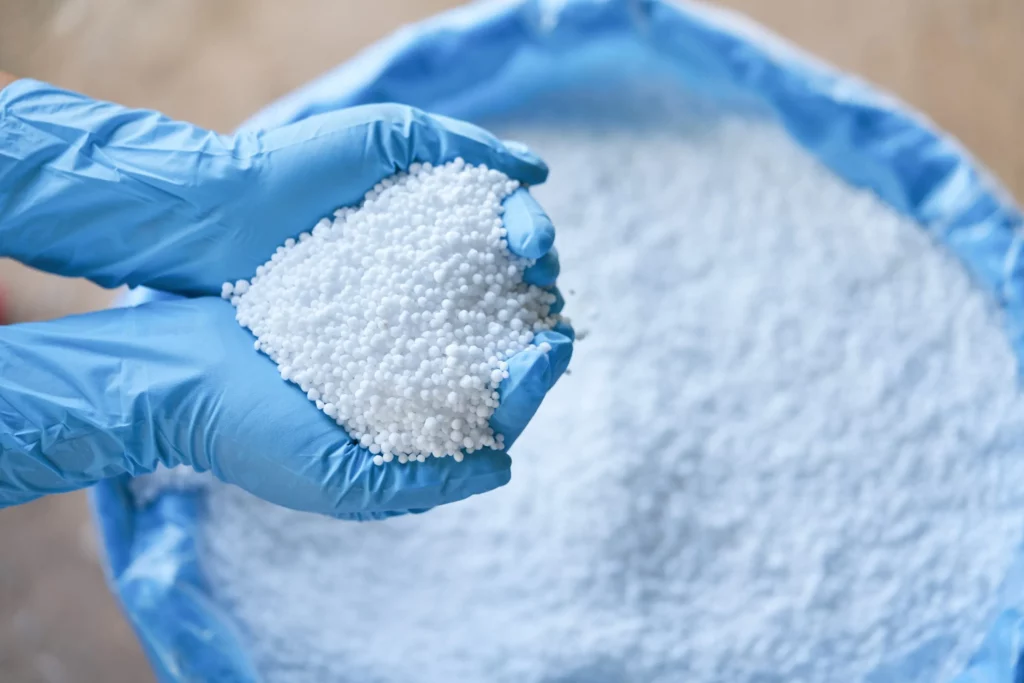
What is urea fertilizer?
Urea, CO(NH2)2, is the world’s most widely used nitrogen fertilizer. It carries 46% nitrogen, the highest of any solid fertilizer, so it is the cheapest way to move and store nitrogen per tonne. In the soil it turns into ammonium and nitrate, which crops use for leaf and stem growth. Read more in what is urea used for and urea in agriculture.
Grades we handle
| Grade | Description | Typical use |
|---|---|---|
| Granular urea 46% | Larger, harder particles, usually 2 to 4 mm | Bulk import, mechanical spreading, blending |
| Prilled urea 46% | Smaller beads, usually 1 to 2.8 mm | Local markets, dissolving, some blends |
| Technical grade urea | High purity, low biuret | Resins, AdBlue production, chemicals |
Typical fertilizer urea specification
| Parameter | Granular | Prilled |
|---|---|---|
| Nitrogen | 46% minimum | 46% minimum |
| Biuret | 1.0% maximum | 1.0% maximum |
| Moisture | 0.5% maximum | 0.5% maximum |
| Particle size | 2 to 4 mm, 90% minimum | 1 to 2.8 mm, 90% minimum |
| Colour | White, free-flowing | White, free-flowing |

Packaging and shipping
- Bulk: in bulk vessels for large volumes
- Bagged: 50 kg bags, or big bags (jumbo bags) of about 1 tonne
- Containers: bagged urea in containers for smaller volumes
Delivery terms such as FOB, CFR or CIF are agreed per contract. See FOB vs CIF.

How a urea purchase works with Agromer
- Enquiry: send the grade, quantity, packaging, destination port and delivery schedule through the form below.
- Letter of Intent: an end-buyer LOI is needed before we issue an offer for urea.
- Offer and SPA: the price, specification, inspection and delivery terms are set out in a sales and purchase agreement.
- Payment: by 100% documentary letter of credit (DLC) or SBLC from a recognised bank.
- Inspection: independent SGS inspection at loading confirms quality and quantity. Factory visits can be arranged once the SPA is signed and the draft LC (MT760) is received.
This is how we keep transactions secure for both sides. Learn more in our trading process and guide on how to assess fertilizer suppliers.
What affects the urea price
Urea follows the world market, which is driven by natural gas costs, export policies, shipping and seasonal demand. The World Bank benchmark (granular urea, FOB Middle East) averaged $407.50 per tonne in September 2026, after averaging about $694 in April to June. Your price also depends on the grade, packaging, quantity and delivery terms. See the full urea price guide.
How to use urea fertilizer
For distributors and farmers, the basics are simple: apply urea during active growth, split the dose, and work it into the soil or apply before irrigation to limit nitrogen losses. Full guidance is in how to use urea as fertilizer.
Frequently asked questions
What grades of urea does Agromer supply?
Granular and prilled fertilizer urea (46% N), and technical grade urea on request.
What is needed to receive a urea offer?
An end-buyer Letter of Intent with the grade, quantity, packaging, destination port and delivery schedule.
How is payment made?
By 100% documentary letter of credit (DLC) or SBLC from a recognised bank, as set out in the sales and purchase agreement.
Is the urea inspected?
Yes. Independent SGS inspection at loading confirms quality and quantity.
What packaging is available?
Bulk, 50 kg bags or big bags, depending on the contract.
What is the difference between granular and prilled urea?
Both contain 46% nitrogen. Granules are larger and harder, better for bulk shipping and blending; prills are smaller and dissolve faster.