
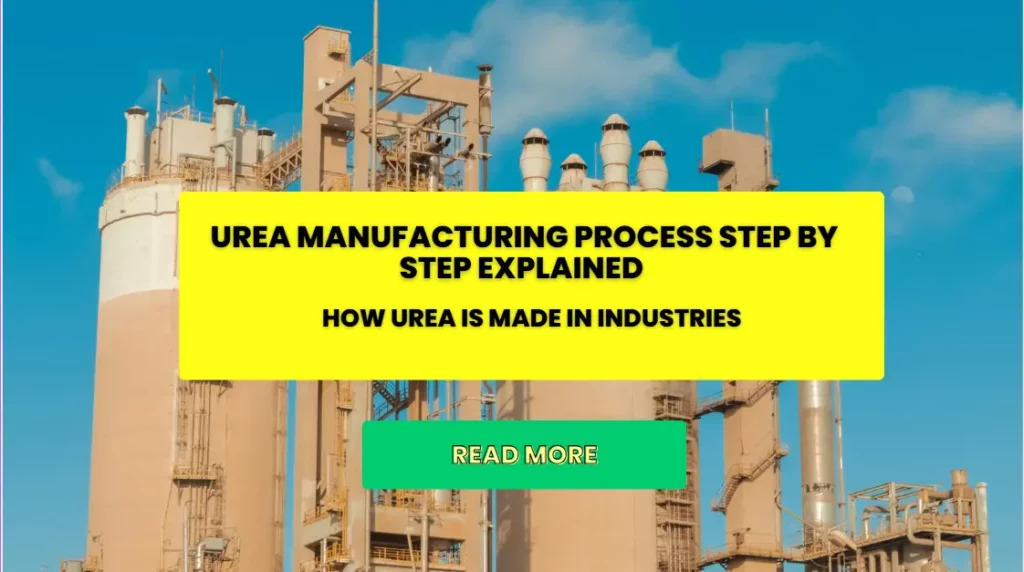
Urea is made by reacting ammonia with carbon dioxide at high pressure and temperature. The two gases first form ammonium carbamate, which then loses water to become urea. Unreacted gases are stripped out and recycled, the urea solution is concentrated into molten urea, and the melt is formed into prills or granules.
This guide explains each step in plain language, the conditions inside a urea plant, the quality limits buyers check, and what is driving production costs in 2026.
Quick answers
- Chemical name
- Carbamide (urea).
- Chemical formula
- CO(NH2)2.
- Raw materials
- Ammonia (NH3) and carbon dioxide (CO2), both usually made from natural gas.
- Nitrogen content
- Fertilizer urea is 46% nitrogen, the highest of any common solid fertilizer.
- How it is produced industrially
- Ammonia and CO2 react at high pressure to form ammonium carbamate, which dehydrates to urea; the melt is then prilled or granulated.
Urea manufacturing at a glance
| Item | Detail |
|---|---|
| Raw materials | Ammonia (NH3) and carbon dioxide (CO2) |
| Reaction 1 | 2 NH3 + CO2 → NH2COONH4 (ammonium carbamate); fast, releases heat |
| Reaction 2 | NH2COONH4 → CO(NH2)2 + H2O (urea + water); slower, needs heat |
| Synthesis loop pressure | About 100 to 250 bar, depending on the technology |
| Reactor temperature | About 170 to 220 °C |
| Finished product | Prilled or granular urea with about 46% nitrogen |
| World production | About 201 million tonnes in 2024 |
What is urea?
Urea, also called carbamide, is a white solid with the formula CO(NH2)2. It contains about 46% nitrogen, the highest of any solid nitrogen fertilizer, and dissolves easily in water. In 1828 the chemist Friedrich Wöhler made urea from inorganic materials, the first time a compound found in living organisms was synthesised in a laboratory.

Step-by-step urea manufacturing process

Step 1: Ammonia and CO2 production
Most urea plants sit next to an ammonia plant. Natural gas (or coal, mainly in China) is converted into hydrogen, which is combined with nitrogen from the air to make ammonia by the Haber-Bosch process. Making the hydrogen also produces CO2, which is captured and sent to the urea plant instead of being released.
Step 2: Synthesis
Compressed ammonia and CO2 enter the high-pressure synthesis loop. They react quickly to form ammonium carbamate and release heat, which the plant reuses to make steam. In the reactor, part of the carbamate then dehydrates into urea and water. This second reaction is slower and does not go to completion, so only part of the feed turns into urea on each pass.
Step 3: Stripping and recycling
The solution leaving the reactor still contains unconverted carbamate, ammonia and CO2. In a stripper, heat and a stripping gas (CO2 or ammonia, depending on the technology) decompose the carbamate back into gases. These are condensed and returned to the reactor, so almost all the ammonia and CO2 end up as urea. Further decomposers at medium and low pressure recover what remains.
Step 4: Concentration
The cleaned urea solution still contains a lot of water. Vacuum evaporators boil it off until only molten urea, almost pure, is left. Temperature control is critical here: too cold and urea crystallises in the equipment, too hot and biuret forms.
Step 5: Prilling or granulation
The melt is turned into solid particles in one of two ways:
- Prilling: molten urea is sprayed from the top of a tall prilling tower. As droplets fall through rising cool air, they solidify into small round prills.
- Granulation: molten urea is sprayed onto small seed particles in a fluidised-bed granulator. Each particle grows layer by layer into a larger, harder granule.
Step 6: Cooling, screening and coating
The product is cooled and screened. Oversized particles are crushed and fed back with the undersized ones as new seed material. Dust from the process is captured in scrubbers. Many producers add an anti-caking treatment, and in India all fertilizer urea is neem-coated. The finished urea is then stored in bulk or bagged.
Prilled vs. granular urea
| Feature | Prilled urea | Granular urea |
|---|---|---|
| How it is made | Droplets solidify while falling through a prilling tower | Built up layer by layer in a granulator |
| Particle size | Smaller | Larger and more uniform |
| Hardness | Softer, more prone to dust | Harder, less breakage in handling |
| Best for | Local use, dissolving, some industrial uses | Bulk shipping, mechanical spreading and blending |
See urea N46 grades for specifications of both forms.
Main urea process technologies
Most of the world’s urea plants use a stripping process licensed by one of a few engineering companies. The main difference is the stripping agent:
- CO2 stripping (Stamicarbon): fresh CO2 is used to strip the reactor solution.
- Ammonia or self-stripping (Saipem, formerly Snamprogetti): ammonia, or heat alone, is used to strip the solution.
- Other licensed processes, such as those from Toyo Engineering, combine stripping and recycling in different ways.
Higher pressure and temperature favour conversion but increase corrosion and equipment cost, so each design balances the two.
Biuret and urea quality standards
Biuret forms when two urea molecules combine at high temperature, releasing ammonia. It can damage seeds, roots and leaves, so producers keep it low through careful temperature control. These are the main quality limits buyers check:
| Parameter | Typical limit | Note |
|---|---|---|
| Total nitrogen | 46% minimum (dry basis) | India Fertiliser Control Order |
| Biuret | 1.5% maximum | India FCO; many export contracts ask for 1.0% maximum |
| Moisture | 1.0% maximum | India FCO |
Industrial users need tighter limits: see technical grade urea and urea powder grades.
What drives the cost of making urea in 2026?
Natural gas is the main raw material and the largest cost in making ammonia, so gas prices set the cost of urea. In September 2026 the World Bank’s European gas price averaged $25.42 per million Btu, more than double the 2025 average of $11.96, while US gas averaged $2.95. Producers with cheap gas, such as those in the Middle East, Russia and the United States, therefore have a large cost advantage over European plants.
This feeds directly into market prices: granular urea averaged $407.50 per tonne FOB Middle East in September 2026, after peaking at an average of about $694 in April to June. See the full urea price guide.
Where is urea made?
World urea production reached about 201 million tonnes in 2024. China is the largest producer, using both gas and coal, followed by India, the Middle East, Russia and the United States. Gulf producers and Russia are the main exporters to the world market. For company names, see the top urea manufacturers.
What is urea used for?
- Fertilizer: the main use, as a nitrogen fertilizer for rice, wheat, maize, sugarcane and other crops.
- Resins and adhesives: urea-formaldehyde resins for plywood, particle board and laminates, and as a raw material for melamine.
- Diesel exhaust fluid: high-purity urea solution (AdBlue) reduces NOx emissions from diesel engines; see DEF urea.
- Animal feed: a controlled non-protein nitrogen source for cattle and other ruminants.
- Cosmetics and pharmaceuticals: moisturising creams and treatments for dry skin.
- Textiles: helps dyes absorb and fix in fabric printing.
Buying urea in bulk
Agromer trades urea with major refineries on spot and contract terms for importers, distributors and industrial buyers. Offers are issued against an end-buyer Letter of Intent with the grade, quantity, packaging and destination. See our urea fertilizer supply page for grades and procedure.
Frequently asked questions
What raw materials are used to make urea?
Ammonia (NH3) and carbon dioxide (CO2). Both usually come from the same ammonia plant: natural gas supplies the hydrogen for ammonia, and CO2 is a by-product of making that hydrogen.
What are the two reactions in urea production?
First, ammonia and carbon dioxide combine to form ammonium carbamate, a fast reaction that releases heat. Second, ammonium carbamate loses water to form urea, a slower reaction that needs heat.
At what pressure and temperature is urea made?
The high-pressure synthesis loop of a urea plant generally runs between about 100 and 250 bar, with reactor temperatures of roughly 170 to 220 °C, depending on the process technology.
What is the difference between prilled and granular urea?
Prills are made by dropping molten urea through a tall tower so the droplets harden as they fall; they are smaller and softer. Granules are built up layer by layer in a granulator; they are larger and harder, which makes them better for bulk shipping and blending.
What is biuret and why does it matter?
Biuret forms when urea is overheated. Too much can damage seeds and leaves. India’s Fertiliser Control Order limits biuret in fertilizer urea to 1.5%, and many export specifications ask for 1.0% or less.
How much urea does the world produce?
About 201 million tonnes in 2024, up from about 195.5 million tonnes in 2023, according to International Fertilizer Association data.