
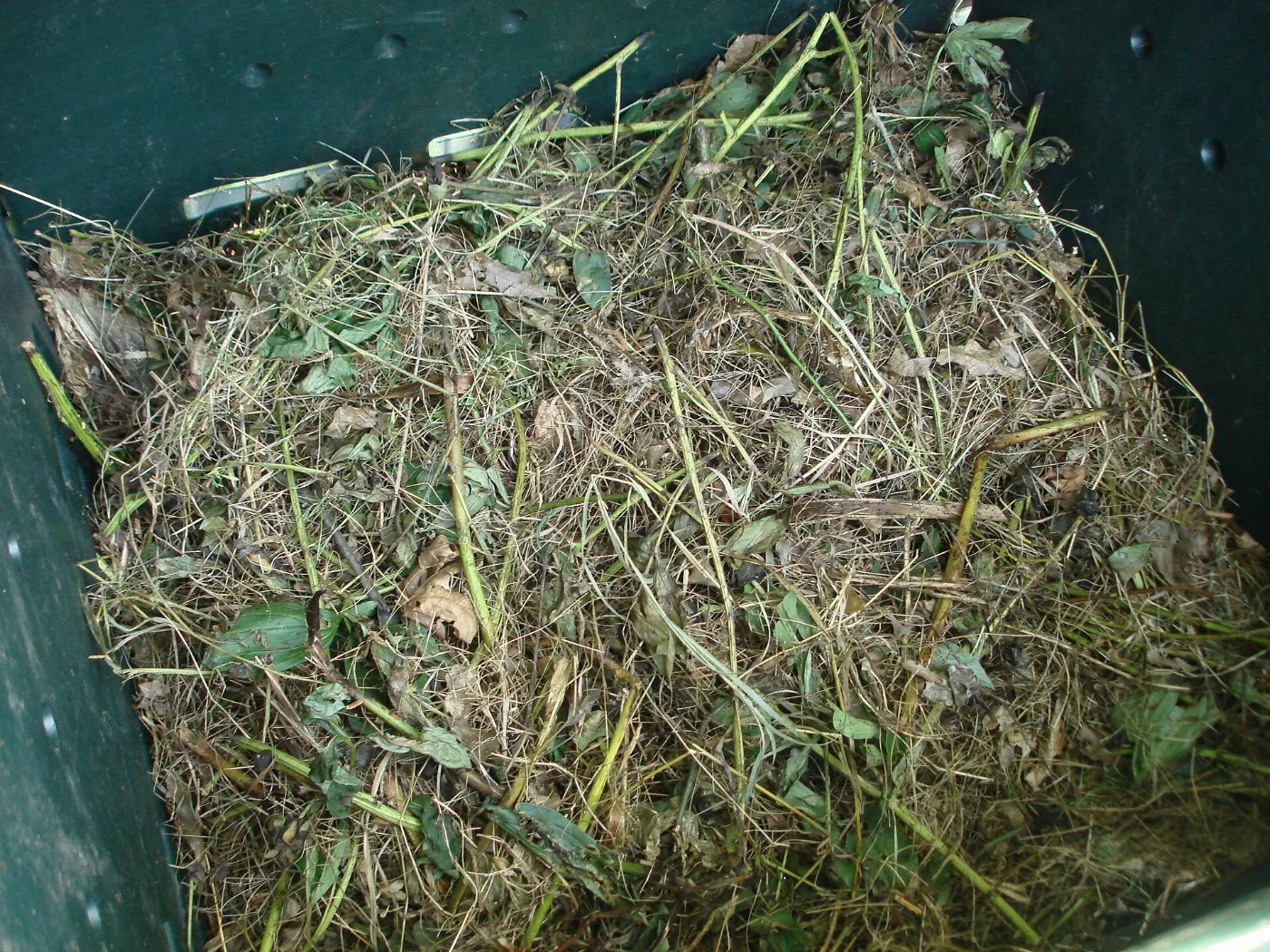
“Organic fertilizer” covers everything from pelleted chicken manure to a litre of seaweed extract. That is the first thing to understand when you look for organic fertilizer manufacturers. A buyer of 5,000 tonnes of composted manure and a buyer of a humic acid concentrate are in different markets, with different suppliers, prices and rules.
This organic fertilizer manufacturers database sorts that out. It gives a verified sample of producers across the main product types, 2024 trade data for animal and vegetable fertilizers by country, an overview of certification rules, and a checklist for importers. You can search and download both tables.
Like our other databases, it is a research resource that we build carefully, one record at a time. It is not a full list of every organic fertilizer supplier, and it does not include anything we could not confirm.

The global organic fertilizer industry
Organic fertilizers come from living or once-living material: manure, crop residues, food waste, fish and animal by-products, seaweed and peat-like deposits. They tend to have lower nutrient concentrations than mineral fertilizers, and they are bought for more than just N, P and K. Buyers want organic matter, better soil structure, or inputs that are allowed in certified organic farming.
That shapes how the market works. Bulky products such as compost and manure are expensive to move, so most are used near where they are made. Trade across borders is dominated by a few high-density livestock regions, which export manure-based products in processed form, and by makers of concentrated specialty products such as seaweed extracts, humic acids and biostimulants, which ship worldwide in drums and bags.
Types of organic fertilizer

| Type | What it is | How it is usually traded |
|---|---|---|
| Compost and manure-based | Composted or dried animal manure and plant material, often pelletised | Bulk, big bags, 25 to 50 kg bags |
| Vermicompost | Compost produced by earthworms | Mostly bags, smaller volumes |
| Animal by-products | Blood meal, bone meal, feather meal, fish meal | Bags and big bags, strict veterinary rules |
| Biofertilizers | Products with living microbes, such as nitrogen-fixing or phosphate-solubilising bacteria | Liquid or powder, with shelf-life limits |
| Seaweed extracts | Liquid or soluble powder extracts of kelp and other seaweeds | Drums, IBCs, bags |
| Humic and fulvic acids | Extracted mainly from leonardite | Granules, powders, liquids |
| Amino acids | Protein hydrolysates from plant or animal sources | Liquid or powder, mostly for foliar use |
Many of these products, especially seaweed extracts, humic substances and amino acids, are now sold as biostimulants rather than fertilizers. In the European Union, for example, plant biostimulants are a separate category under the EU Fertilising Products Regulation (EU) 2019/1009. The label matters, because it decides which rules apply.
For a farmer’s view of the difference, see organic vs chemical fertilizers. For specific products, read our guides to cow dung fertilizer and blood and bone fertilizer.
How organic fertilizers are made
The process depends on the raw material.
- Composting breaks down manure and plant material under controlled temperature and aeration. Good composting also reduces pathogens and weed seeds.
- Drying and pelletising turn manure or compost into dense, low-odour pellets that are much cheaper to ship.
- Rendering and hydrolysis process animal by-products into meals or amino acid liquids.
- Extraction pulls active compounds out of seaweed or leonardite using water, alkali or other methods.
- Fermentation grows the microbes used in biofertilizers.
Each step affects nutrient content, moisture, safety and shelf life. Ask suppliers how they control them.
Search the organic fertilizer manufacturers database
The table lists organic fertilizer, seaweed, humic and biostimulant manufacturers we confirmed in October 2026, on the company’s own website or on Wikipedia. “Products confirmed” shows only what that source states.
| Company | Country | Region | Products confirmed | Country HS 3101 exports 2024 (kt) | Official website | Verified via (Oct 2026) |
|---|---|---|---|---|---|---|
| Acadian Plant Health | Canada | North America | Biostimulants | 30 | acadianplanthealth.com | Official website |
| Frayssinet | France | Europe | Fertilisers and biostimulants | 63 | frayssinet.fr | Official website |
| Humintech | Germany | Europe | Humic acid products | 146 | humintech.com | Official website |
| Coromandel International | India | South Asia | Organic fertiliser | 23 | coromandel.biz | Official website |
| Petrokimia Gresik | Indonesia | Southeast Asia | Organic fertilizer (Petroganik) | 27 | petrokimia-gresik.com | Wikipedia |
| Ferm O Feed | Netherlands | Europe | Organic fertilisers, biostimulants | 1,487 | fermofeed.com | Official website |
| Kelp Products International (Kelpak) | South Africa | Sub-Saharan Africa | Seaweed biostimulant (Ecklonia maxima) | 16 | kelpak.com | Official website |
| Bioiberica | Spain | Europe | Biostimulants | 99 | bioiberica.com | Official website |
Organic fertilizer producers we confirmed in October 2026, on the company's official website or, where the website blocks automated checks, on Wikipedia (linked in the last column). "Products confirmed" lists only what that source states. This is a verified sample, not a complete list, and inclusion does not mean Agromer represents the company. Russian and Belarusian producers: check the sanctions rules that apply to you. Country export figures: UN Comtrade, HS 3101 (animal or vegetable fertilizers, including manure and compost based products), 2024; blank means not reported. *Many seaweed extracts, humic products and biostimulants are classified under other HS headings, so they are not included here.
Organic fertilizer trade by country, 2023 and 2024
The second table uses UN Comtrade data for HS heading 3101, “animal or vegetable fertilizers”. This heading covers manure, compost and similar products. Many seaweed extracts, humic products and biostimulants are classified under other headings, so they are not in these figures.
| Country | Exports 2023 (kt) | Exports 2024 (kt) | Avg export value 2024 ($/t) | Imports 2023 (kt) | Imports 2024 (kt) | Avg import value 2024 ($/t) |
|---|---|---|---|---|---|---|
| Albania | 0.5 | 4.1 | 4.4 | |||
| Algeria | value $2.3M, no tonnage | |||||
| Andorra | 3.6 | 3.4 | ||||
| Angola | <0.1 | <0.1 | 1.2 | 1.9 | ||
| Antigua and Barbuda | 0.2 | 0.2 | ||||
| Argentina | 0.6 | 4 | 3.2 | |||
| Armenia | <0.1 | 0.2 | 0.2 | |||
| Aruba | <0.1 | 2.2 | ||||
| Australia | 24 | 21 | 7 | 8.3 | ||
| Austria | 52 | 45 | 42 | 49 | ||
| Azerbaijan | 5.3 | 6.6 | 1.1 | 1.4 | ||
| Bahamas | value $1.0M, no tonnage | value $0.8M, no tonnage | ||||
| Bahrain | value $0.3M, no tonnage | 4 | ||||
| Barbados | <0.1 | <0.1 | <0.1 | |||
| Belgium | 1,498 | 1,489 | 118 | 484 | 505 | 52 |
| Belize | <0.1 | <0.1 | 0.4 | 0.1 | ||
| Benin | 0.1 | <0.1 | <0.1 | |||
| Bermuda | <0.1 | <0.1 | ||||
| Bhutan | <0.1 | |||||
| Bolivia (Plurinational State of) | <0.1 | value $2.1M, no tonnage | value $1.2M, no tonnage | |||
| Bosnia Herzegovina | 0.1 | 0.2 | 3.6 | 4.3 | ||
| Botswana | 0.8 | 0.3 | 0.5 | 0.7 | ||
| Brazil | 14 | 15 | 10 | 12 | ||
| Brunei Darussalam | 0.1 | 0.3 | ||||
| Bulgaria | 0.5 | 0.4 | 10 | 9 | ||
| Burkina Faso | <0.1 | 0.1 | ||||
| Burundi | <0.1 | |||||
| Cabo Verde | 0.1 | 0.1 | ||||
| Cambodia | <0.1 | <0.1 | 76 | 97 | 232 | |
| Cameroon | <0.1 | |||||
| Canada | 33 | 30 | 15 | 28 | ||
| Cayman Isds | value $0.5M, no tonnage | value $0.5M, no tonnage | ||||
| Central African Rep. | 0.1 | |||||
| Chile | 9.3 | 6.9 | 6.7 | 7.2 | ||
| China | 54 | 86 | 272 | 7.6 | 8.5 | |
| China, Hong Kong SAR | 0.1 | 1.8 | 1 | |||
| Colombia | 1.2 | 1.1 | 12 | 1.1 | ||
| Comoros | 0.1 | |||||
| Congo | <0.1 | 0.1 | 0.3 | |||
| Costa Rica | 0.3 | 0.4 | ||||
| Croatia | 0.9 | 0.3 | 16 | 16 | ||
| Cyprus | <0.1 | 4 | 4.8 | |||
| Czechia | 80 | 139 | 58 | 70 | 73 | 113 |
| Côte d'Ivoire | 5.3 | 1.8 | 4.9 | 3.6 | ||
| Dem. Rep. of the Congo | <0.1 | 0.1 | ||||
| Denmark | 1.8 | 9.3 | 7.5 | 7.1 | ||
| Djibouti | <0.1 | |||||
| Dominica | 0.1 | |||||
| Dominican Rep. | 7.9 | 11 | 5.1 | 5.2 | ||
| Ecuador | value $0.6M, no tonnage | <0.1 | value $2.8M, no tonnage | 1.6 | ||
| Egypt | value $6.4M, no tonnage | value $3.9M, no tonnage | value $0.2M, no tonnage | |||
| El Salvador | <0.1 | 0.2 | ||||
| Estonia | 4.2 | 3.8 | 12 | 16 | ||
| Eswatini | 0.1 | 5.8 | ||||
| Ethiopia | 0.1 | |||||
| Fiji | <0.1 | <0.1 | 0.1 | 0.2 | ||
| Finland | 1.3 | 1 | 2.7 | 3.4 | ||
| France | 51 | 63 | 849 | 868 | 802 | 119 |
| French Polynesia | <0.1 | <0.1 | ||||
| Gabon | <0.1 | <0.1 | ||||
| Gambia | <0.1 | 1.6 | ||||
| Georgia | <0.1 | 5.6 | 7 | |||
| Germany | 87 | 146 | 231 | 81 | 113 | 387 |
| Ghana | <0.1 | 0.1 | 2.2 | 4.1 | ||
| Greece | 1.6 | 1.7 | 7.7 | 15 | ||
| Grenada | <0.1 | |||||
| Guatemala | 0.2 | 0.2 | 1.3 | 1.7 | ||
| Guyana | <0.1 | <0.1 | <0.1 | |||
| Honduras | 0.1 | 0.1 | <0.1 | 0.1 | ||
| Hungary | 24 | 19 | value $11.4M, no tonnage | 9.2 | ||
| Iceland | <0.1 | <0.1 | 0.1 | 0.1 | ||
| India | 23 | 23 | 15 | 14 | ||
| Indonesia | 24 | 27 | 6.9 | 6.3 | ||
| Iran | 0.4 | 4.7 | ||||
| Iraq | 143 | 24 | ||||
| Ireland | 29 | 36 | 49 | 48 | ||
| Israel | value $2.9M, no tonnage | value $7.8M, no tonnage | value $2.4M, no tonnage | value $2.6M, no tonnage | ||
| Italy | 136 | 166 | 1,121 | 62 | 75 | 849 |
| Jamaica | <0.1 | <0.1 | 0.1 | |||
| Japan | 296 | 339 | 63 | 38 | 33 | |
| Jordan | 0.3 | 0.7 | ||||
| Kazakhstan | <0.1 | 0.1 | 1.6 | 0.9 | ||
| Kenya | 0.2 | 0.1 | 1.1 | 0.4 | ||
| Kuwait | 0.5 | value $0.2M, no tonnage | ||||
| Kyrgyzstan | 0.3 | <0.1 | <0.1 | 0.1 | ||
| Lao People's Dem. Rep. | <0.1 | 65 | ||||
| Latvia | 13 | 17 | 1.3 | 1.1 | ||
| Lebanon | value $0.3M, no tonnage | value $2.2M, no tonnage | value $3.1M, no tonnage | |||
| Lesotho | 4.8 | 1.9 | ||||
| Liberia | <0.1 | <0.1 | ||||
| Lithuania | 33 | 42 | 14 | 14 | ||
| Luxembourg | 0.1 | 0.1 | value $0.9M, no tonnage | 2.4 | ||
| Madagascar | 0.2 | <0.1 | 1 | 1.4 | ||
| Malawi | <0.1 | <0.1 | 0.7 | 0.1 | ||
| Malaysia | 3 | 3.1 | 13 | value $6.5M, no tonnage | ||
| Maldives | 9.8 | 11 | ||||
| Mali | 1.6 | 5.3 | 0.1 | |||
| Malta | 0.8 | 1 | ||||
| Mauritania | 22 | 19 | 26 | 20 | ||
| Mauritius | 0.1 | 0.2 | ||||
| Mexico | 4.3 | 5 | 0.6 | 0.2 | ||
| Mongolia | 0.1 | <0.1 | ||||
| Montenegro | 2.1 | 0.8 | 1.2 | |||
| Montserrat | <0.1 | <0.1 | ||||
| Morocco | <0.1 | 0.1 | 0.4 | 0.6 | ||
| Mozambique | <0.1 | 0.8 | 0.5 | |||
| Myanmar | 27 | 28 | ||||
| Namibia | 3 | 2.2 | 1 | 0.9 | ||
| Netherlands | 1,326 | 1,487 | 154 | 132 | 144 | 418 |
| New Zealand | 0.4 | 0.2 | 2.5 | 4 | ||
| Nicaragua | <0.1 | <0.1 | 0.2 | 0.1 | ||
| Niger | <0.1 | |||||
| Nigeria | <0.1 | <0.1 | ||||
| North Macedonia | <0.1 | <0.1 | 1.2 | 1.2 | ||
| Norway | 11 | 12 | 2.7 | 3 | ||
| Oman | <0.1 | <0.1 | 3.8 | 4.2 | ||
| Other Asia, nes (Taiwan) | 5.7 | value $2.4M, no tonnage | 55 | value $9.8M, no tonnage | ||
| Pakistan | 2.8 | 3.3 | ||||
| Panama | 2.1 | 1.6 | ||||
| Papua New Guinea | <0.1 | 0.2 | 0.1 | |||
| Paraguay | 0.3 | 0.3 | 10 | 8.2 | ||
| Peru | 4.5 | 2.4 | 5.2 | 6.3 | ||
| Philippines | 0.7 | 0.5 | 2.7 | 3 | ||
| Poland | 28 | 9 | 209 | 161 | 242 | |
| Portugal | 6.9 | 21 | 82 | 73 | 592 | |
| Qatar | value $0.4M, no tonnage | 0.6 | ||||
| Rep. of Korea | 52 | 118 | 170 | 19 | 15 | |
| Rep. of Moldova | <0.1 | 0.7 | 0.7 | |||
| Romania | 2.9 | 3.6 | 32 | 18 | ||
| Rwanda | <0.1 | 0.1 | 0.1 | |||
| Saint Vincent and the Grenadines | <0.1 | <0.1 | ||||
| Samoa | <0.1 | 0.1 | ||||
| Sao Tome and Principe | <0.1 | 0.3 | ||||
| Saudi Arabia | value $0.3M, no tonnage | 5.3 | value $4.9M, no tonnage | 22 | ||
| Senegal | 4.1 | 0.4 | 1.4 | 1.6 | ||
| Serbia | 0.3 | 0.2 | 1.9 | 3.9 | ||
| Seychelles | <0.1 | 0.1 | ||||
| Singapore | 0.9 | <0.1 | 1.3 | 0.5 | ||
| Slovakia | 9.4 | 8.5 | 6.1 | 5.1 | ||
| Slovenia | 2.4 | 3.1 | 7.4 | 9.4 | ||
| South Africa | 14 | 16 | 5.3 | 4.3 | ||
| Spain | 111 | 99 | 794 | 58 | 70 | 1,055 |
| Sri Lanka | 6.5 | 5.4 | 0.2 | 0.2 | ||
| State of Palestine | value $1.3M, no tonnage | value $14.4M, no tonnage | ||||
| Suriname | 0.1 | 0.1 | ||||
| Sweden | 6.6 | 4.1 | 25 | 20 | ||
| Switzerland | 12 | 13 | 19 | 18 | ||
| Tajikistan | <0.1 | |||||
| Thailand | 19 | 13 | 1 | 1.5 | ||
| Timor-Leste | 0.1 | |||||
| Togo | <0.1 | 5.1 | <0.1 | |||
| Tonga | value $0.1M, no tonnage | |||||
| Trinidad and Tobago | <0.1 | <0.1 | <0.1 | 0.1 | ||
| Tunisia | 0.3 | 1 | value $1.1M, no tonnage | |||
| Türkiye | 17 | 20 | 8.9 | 6.9 | ||
| USA | 795 | 290 | 174 | 68 | 55 | 1,231 |
| Uganda | 0.1 | <0.1 | 0.7 | 0.5 | ||
| Ukraine | 0.3 | 0.3 | 1.1 | 0.6 | ||
| United Arab Emirates | 0.8 | 11 | ||||
| United Kingdom | 20 | 27 | 61 | 67 | 506 | |
| United Rep. of Tanzania | <0.1 | 0.1 | 0.2 | |||
| Uruguay | <0.1 | <0.1 | 31 | 24 | ||
| Uzbekistan | <0.1 | <0.1 | 0.7 | 0.4 | ||
| Viet Nam | 58 | value $112.2M, no tonnage | ||||
| Yemen | <0.1 | 0.1 | 26 | 26 | ||
| Zambia | 0.2 | <0.1 | 0.3 | 1.6 | ||
| Zimbabwe | 0.1 | 0.1 | 1.2 | 0.7 |
Sources: UN Comtrade, HS 3101 (animal or vegetable fertilizers, including manure and compost based products), reporter data for 2023 and 2024, retrieved October 2026. Average values are reported value divided by reported weight (exports usually FOB, imports usually CIF), shown only for larger flows. Blank cells mean not reported. *Many seaweed extracts, humic products and biostimulants are classified under other HS headings, so they are not included here.
Who exports organic fertilizer
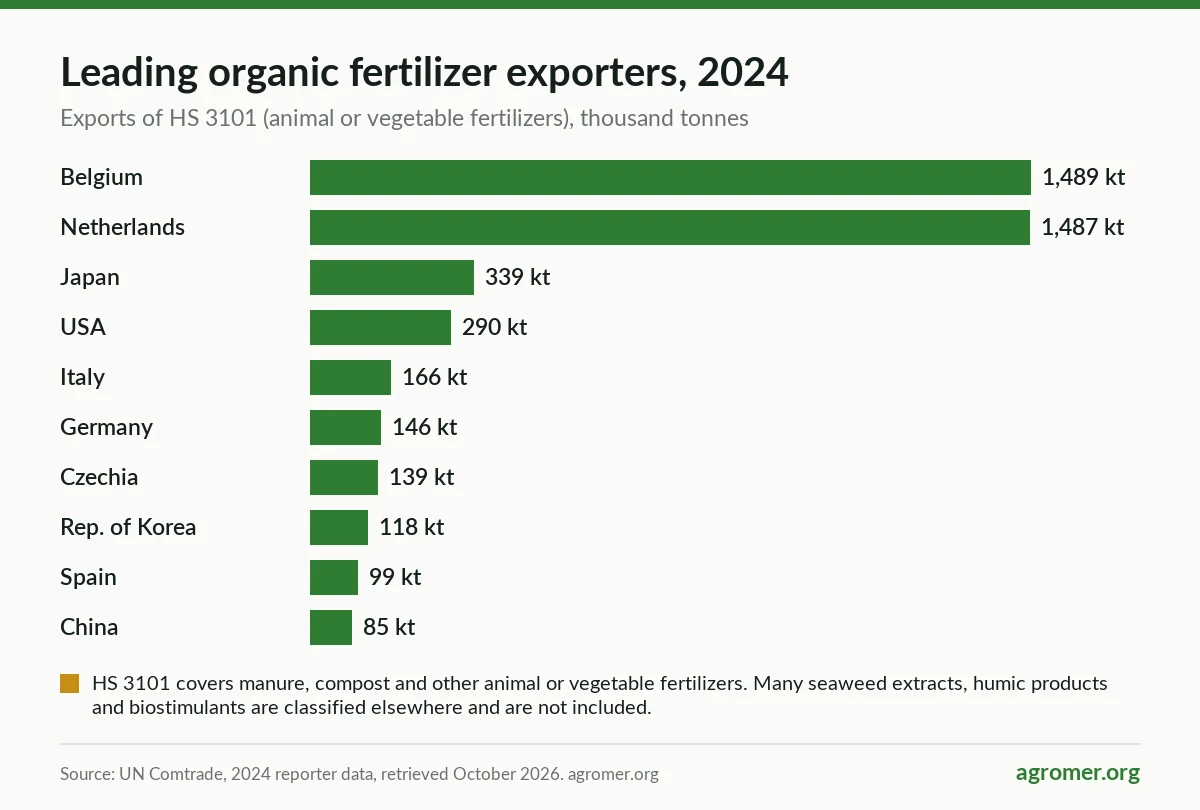
In 2024, Belgium and the Netherlands each exported about 1.49 million tonnes of HS 3101 products, far more than any other country. Both have dense livestock farming and strict limits on how much manure farmers can spread, so processed manure is exported. Japan (0.34 million tonnes), the United States (0.29 million), Italy (0.17 million) and Germany (0.15 million) followed.
The values tell a different story from the volumes. Belgian exports averaged about $118 per tonne and Dutch exports about $153. Italian exports averaged about $1,120 per tonne and Spanish exports about $800. Same customs heading, very different products: bulk manure on one side, refined organic fertilizers and specialty products on the other.
The largest importers in 2024 were France (0.80 million tonnes), Belgium (0.51 million), Poland (0.16 million), the Netherlands (0.14 million) and Germany (0.11 million). In other words, much of the HS 3101 trade happens inside Europe.
Certification and quality requirements
This is where organic fertilizer sourcing gets difficult. Requirements depend on the destination market and on whether the product is meant for certified organic farming.
- European Union: fertilising products can be placed on the market under national rules or, with CE marking, under Regulation (EU) 2019/1009. Inputs for certified organic farming must also be authorised under the EU organic rules (Regulation (EU) 2018/848 and its implementing acts). Manure and other animal by-products must meet the animal by-products rules, Regulation (EC) 1069/2009.
- United States: products for certified organic farms must comply with the USDA National Organic Program. Many suppliers use OMRI listing to show compliance. Each state also regulates fertilizer registration and labelling.
- India: organic fertilizers and biofertilizers are covered by the Fertiliser Control Order, which sets specifications for each product.
Whatever the market, ask for laboratory analysis of nutrient content, organic matter, moisture, heavy metals and, for manure-based products, pathogens. For biofertilizers, ask for the microbial count and shelf life. And check whether your country requires a phytosanitary or veterinary certificate.
How to choose an organic fertilizer supplier
- Define the product: compost, manure pellets, biofertilizer, seaweed extract or humic product.
- Check the claims: “organic” on a label is not the same as approval for certified organic farming.
- Ask for test reports: recent, from an independent laboratory, for the batch you will receive.
- Confirm the manufacturer: many brands are made under contract, so ask who produces the product and where.
- Plan logistics: bulky products need low-cost transport; liquids need suitable containers and temperature control.
- Confirm minimum quantities and packaging: these vary widely between suppliers.
- Check import rules early: registration, labelling, veterinary and phytosanitary requirements can take months.
- Agree inspection and payment terms before shipment.
See also how to choose an organic fertilizer brand and how to assess fertilizer suppliers.
Why use an organic fertilizer database
- Separate bulk organic products from specialty and biostimulant products.
- See which countries export and import each type at scale.
- Confirm that a manufacturer makes what it claims.
- Understand the certification rules before you commit to a product.
- Prepare a precise enquiry, with the right product definition and documents.
Organic fertilizers from Agromer
Agromer has been an international commodity trader since 1985, based in Saint-Avertin, France. Our fertilizer range includes manure pellets and liquid biofertilizers. Tell us the product, the quantity, the packaging, the destination and whether it must be approved for certified organic farming, and we will check what we can offer. You can also see our organic fertilizer page.
Frequently asked questions
What types of organic fertilizer are traded internationally?
Processed manure and compost, animal by-product meals, biofertilizers, seaweed extracts, humic and fulvic acid products, and amino acid products. Bulk manure products trade mainly between neighbouring countries, while concentrated specialty products ship worldwide.
Which countries export the most organic fertilizer?
Belgium and the Netherlands each exported about 1.49 million tonnes of HS 3101 animal or vegetable fertilizers in 2024, according to UN Comtrade. Japan and the United States followed.
Is organic fertilizer the same as a biostimulant?
Not always. Organic fertilizers supply nutrients from organic material. Biostimulants, such as many seaweed and humic products, aim to improve nutrient uptake or stress tolerance. Many markets now regulate them separately.
What certification do organic fertilizers need?
It depends on the market. In the EU, products for certified organic farming must be authorised under the EU organic regulation. In the US, they must comply with the National Organic Program, often shown through OMRI listing.
Why do organic fertilizer prices vary so much?
Because the products are so different. In 2024, Belgian HS 3101 exports averaged about $118 per tonne, while Italian exports averaged about $1,120. Bulk manure and refined specialty products sit under the same customs heading.
What should I test before importing organic fertilizer?
Nutrient content, organic matter, moisture, heavy metals and, for manure-based products, pathogens such as Salmonella and E. coli. For biofertilizers, check the microbial count and expiry date.
Can I download the organic fertilizer manufacturers list?
Yes. Use the Download CSV button above either table. The file includes the source note.