
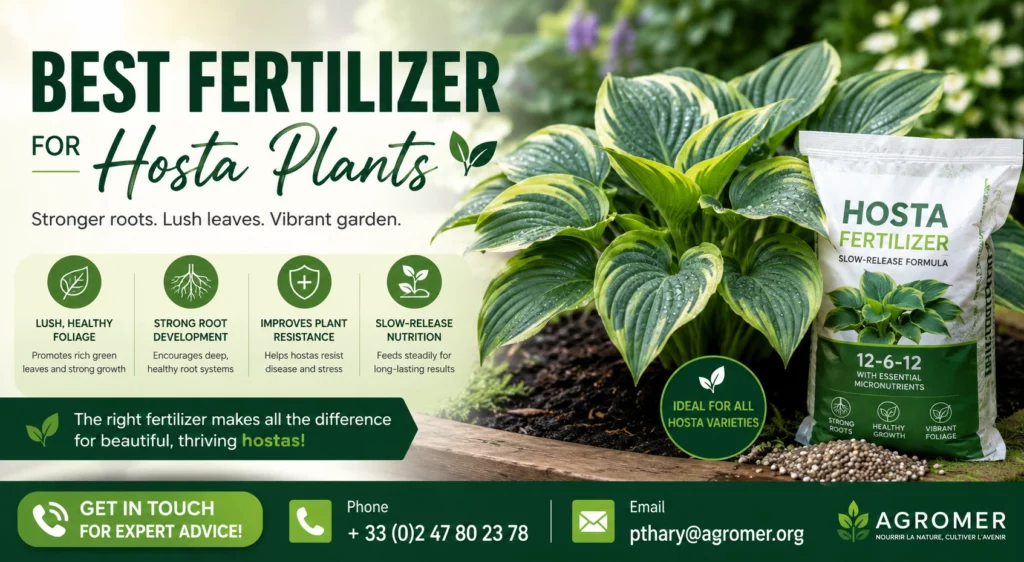
Discover the best fertilizer for hosta plants to boost growth, color, and health. Expert tips from Agromer, trusted fertilizer supplier.
Top & Best Fertilizer for Hosta Plants Supplier, Dealer, Exporter & Manufacturer
Need help in sourcing best fertilizer for hosta palnts as per your needs, then feel free to get touch with us.
Phone no: + 33 (0)2 47 80 23 78
Email: pthary@agromer.org
Why Your Hostas Aren’t Living Up to Their Potential
You planted hostas because they promised low-maintenance beauty. Those broad, elegant leaves were supposed to fill your shaded garden beds with lush greenery. And yet — the leaves look pale, growth has slowed to a crawl, and no amount of watering seems to make a difference.
Sound familiar?
The answer, more often than not, comes down to feeding. Choosing the best fertilizer for hosta plants is the single most impactful decision you can make for these shade-loving perennials. Get it right, and hostas reward you with dramatic foliage, deep color, and vigorous spreads year after year.
Get it wrong, and you’re stuck wondering what you missed.
This guide walks you through everything you need to know — the right nutrients, the right timing, the right application methods — backed by real agronomic expertise from Agromer, one of the leading fertilizer suppliers and agricultural solution providers.
About Agromer: Growing Agriculture, Growing
Agromer is a dedicated fertilizer supplier and trader committed to bridging the gap between modern agricultural science and the everyday grower — whether that’s a commercial farmer managing hundreds of acres or a passionate home gardener nurturing a shaded hosta collection.
Our Mission
Agromer’s mission is simple: make quality, science-backed fertilizers accessible to every grower across india and beyond. We believe better nutrition leads to better yields, healthier plants, and more sustainable growing practices.
Our Vision
We envision an india where soil health is never compromised — where farmers and gardeners have access to the right inputs at the right time, supported by practical knowledge they can actually use.
What We Do
Agromer sources, supplies, and trades a wide range of fertilizer products including:
Granular slow-release fertilizers
Water-soluble complete fertilizers
Organic and bio-based soil amendments
Micronutrient blends and corrective supplements
Custom NPK formulations for specific crops and ornamentals
We work closely with farmers, horticulturists, nursery owners, and agricultural distributors across india, helping them select the most effective products for their specific soil conditions and plant needs.
Understanding What Hosta Plants Actually Need
Before reaching for any fertilizer bag, it helps to understand the nutritional biology of hostas.
Hostas are foliage-first plants. Unlike flowering annuals that channel energy into blooms, hostas invest almost everything into their leaves — those wide, dramatically textured, variegated canvases that make them standout plants in any shaded landscape.
That means their nutritional priorities are a bit different.
The Big Three: NPK for Hostas
Nitrogen (N) is the primary driver of lush, green leaf growth. Hostas are heavy users of nitrogen during their active spring and early summer growth period.
Phosphorus (P) supports root development and helps the plant establish itself firmly. Strong roots mean better drought resistance and more vigorous emergence each spring.
Potassium (K) is the all-rounder — it regulates water movement within plant cells, strengthens cell walls, and improves overall disease resistance.
A balanced fertilizer with a ratio close to 10-10-10 or slightly nitrogen-heavy like 12-6-6 works well for most hostas. However, the exact needs can vary depending on your existing soil health.
Secondary Nutrients and Micronutrients
Don’t overlook iron, magnesium, and calcium. Pale, yellowish leaves on hostas — a common complaint — are frequently a sign of iron deficiency or magnesium imbalance rather than a nitrogen shortage. Agromer’s micronutrient blends are specifically designed to address these deficiencies without the guesswork.
The Best Fertilizer Types for Hosta Plants
Not all fertilizers perform equally in all situations. Here’s a practical breakdown of your options.
1. Granular Slow-Release Fertilizers
Granular fertilizers coated with a controlled-release polymer are arguably the most practical choice for hostas. You apply them once at the start of the growing season, and they continue feeding the plant steadily over 3–6 months.
Best for: Established hosta clumps in garden beds
Application tip: Scratch the granules lightly into the soil surface around the plant’s drip line — never pile them directly against the crown.
Agromer’s slow-release granular blends are formulated with consistent nutrient release curves, which means your plants receive steady nutrition rather than alternating between feast and famine.
2. Water-Soluble Fertilizers
Liquid or water-soluble fertilizers work faster than granulars. They’re absorbed through both the roots and, to a lesser extent, the foliage. This makes them ideal for quick corrections when you spot a deficiency mid-season.
Best for: Container hostas, recently divided transplants, or plants showing deficiency symptoms
Application tip: Mix according to label directions and apply every 2–3 weeks during active growth. Stop by late summer to avoid pushing tender new growth that could be damaged by early frost.
3. Organic Fertilizers and Compost
Compost, vermicast, bone meal, and blood meal are excellent long-term soil builders for hosta beds. They don’t deliver nutrients as rapidly as synthetics, but they dramatically improve soil structure, beneficial microbial activity, and moisture retention — all of which hostas thrive in.
Best for: Annual soil preparation and long-term bed health
Application tip: Work 2–3 inches of compost into the top 6 inches of soil before planting, or apply it as a top-dressing around established plants each autumn.
Agromer sources and supplies premium organic amendments that complement synthetic programs, giving growers the best of both worlds.
4. Balanced NPK Fertilizers (10-10-10 or 14-14-14)
A classic balanced NPK fertilizer remains one of the most versatile options for hostas. It provides all three major nutrients in equal proportions, making it a reliable choice when you haven’t done a soil test and aren’t sure what your beds are lacking.
When to Fertilize Hosta Plants: Timing Matters as Much as the Product
Choosing the right fertilizer product is only half the equation. Applying it at the wrong time can waste money — or worse, damage your plants.
Early Spring: The Critical Window
Apply your first fertilizer dose when hosta tips are just emerging from the soil — typically when soil temperatures reach around 10°C. This is when the plant begins actively growing and can make best use of available nutrients.
Mid-Spring to Early Summer: Peak Feeding Period
If you’re using a liquid fertilizer, continue applications every 2–3 weeks through late June. This is when hostas are doing the bulk of their foliar development.
Late Summer: Stop Feeding
Fertilizing after August in most climates (or after the monsoon season in India) encourages soft, tender new growth that won’t harden properly before dormancy. This leaves plants vulnerable to frost damage and disease.
Autumn: Soil Preparation
After leaves die back, apply organic matter or a low-nitrogen winter soil amendment to rebuild soil health for the following season. This step is especially valuable in Indian growing conditions where soil organic matter tends to deplete quickly.
Why Indian Gardeners and Farmers Choose Agromer
India’s agricultural landscape is unique — diverse soil types, highly variable rainfall patterns, and an enormous range of crops and ornamentals grown across the country.
What works in Punjab’s alluvial plains won’t necessarily work in the red laterite soils of Karnataka or the black cotton soils of Maharashtra. Agromer understands this complexity.
Here’s why growers across India rely on Agromer:
Soil-Specific Recommendations — We don’t just sell fertilizer; we help you match the right product to your actual soil and crop needs.
Consistent Supply Chain — Seasonal fertilizer shortages are a real challenge in India. Agromer maintains reliable inventory and distribution networks to ensure product availability when you need it.
Quality Assurance — Every product in our range is sourced from verified manufacturers and meets quality standards. No fillers, no adulteration.
Affordable Pricing — Quality fertilizer doesn’t have to break the bank. Our direct sourcing relationships allow us to offer competitive pricing without compromising on product integrity.
Expert Support — Whether you’re a commercial farmer or a home garden enthusiast, our team can guide you toward the right product choice.
How the Agromer Process Works
Working with Agromer is designed to be straightforward, even for first-time buyers.
Step 1: Identify Your Needs
Start with a basic assessment — what plant or crop, what growth stage, what region, and if possible, what soil type. Our team or your local agronomist can help with this.
Step 2: Product Selection
Based on your needs, Agromer recommends the most appropriate fertilizer — whether that’s a granular slow-release blend, a water-soluble complete fertilizer, or an organic amendment.
Step 3: Order and Delivery
Place your order through our network of distributors or directly with the Agromer team. We manage logistics to ensure timely delivery.
Step 4: Application Guidance
We provide clear, practical instructions on how to apply each product — rates, timing, method, and safety precautions. No guessing.
Step 5: Follow-Up and Adjustment
Good nutrition management is an ongoing process. We encourage follow-up conversations to track plant response and adjust programs as needed.
Use Cases: Where Agromer Fertilizers Deliver Results
Home Gardens and Landscape Beds
For gardeners growing hostas in shaded borders or container arrangements, Agromer’s balanced granular fertilizers provide simple, effective seasonal nutrition without constant reapplication.
Nurseries and Plant Growers
Nurseries propagating and selling hostas benefit from consistent, fast-acting water-soluble blends that accelerate production cycles and produce saleable plants faster.
Landscape Contractors
Professionals installing hosta plantings in commercial landscapes need reliable, predictable performance. Slow-release formulations reduce labor by cutting back on reapplication frequency.
Organic and Sustainable Growers
For those committed to organic production, Agromer’s bio-based amendments and organic fertilizers offer effective plant nutrition that builds soil health over time.
Practical Tips for Fertilizing Hostas the Right Way
These are the kind of insights that come from working with plants season after season — not just reading about them.
Do a soil test before you guess. A basic soil test costs very little and tells you exactly what your soil is lacking. Fertilizing blind often leads to over-application of nutrients that are already adequate and under-application of what’s actually needed.
Water thoroughly after fertilizer application. Dry granules sitting on the soil surface can scorch roots if they don’t get watered in promptly. After applying any granular fertilizer, water the area well.
Split your applications. Rather than applying one large dose of a fast-release fertilizer, split it into two or three smaller applications across the growing season. This reduces leaching and gives the plant a steadier supply.
Never fertilize drought-stressed plants. If your hostas are wilting from lack of water, feed them water first. Fertilizing a stressed plant adds salt load to already-struggling roots.
Go easy on container hostas. Potted hostas have limited soil volume and nutrients concentrate more quickly. Use a diluted liquid fertilizer at half the recommended rate for containers.
Mulch your hosta beds. A 2–3 inch layer of organic mulch over your hosta beds helps retain moisture, moderates soil temperature, and slowly adds organic matter as it breaks down. This reduces fertilizer requirements and keeps plants happier overall.
The Bigger Picture: Agriculture Trends and the Growing Importance of Soil Nutrition
India’s agricultural sector is changing rapidly. The shift toward precision farming, the growing interest in sustainable growing practices, and rising consumer awareness about food quality are all reshaping how farmers and growers think about inputs.
Fertilizer is at the center of this conversation.
Overuse of urea and other nitrogen-heavy fertilizers has degraded soil health across large parts of India over the past three decades. The solution isn’t to abandon fertilizers — it’s to use them smarter.
Balanced, complete nutrition programs that include micronutrients, organic matter, and soil biology-supporting amendments are the direction the industry is moving. Agromer is positioned squarely within this shift, offering product ranges that go beyond simple NPK to support holistic soil and plant health.
For growers of ornamentals like hostas, this shift is equally relevant. Better soil means better plants — period.
Conclusion: Give Your Hostas the Nutrition They Deserve
Hostas are forgiving plants in many ways. They tolerate shade, handle competition, and come back reliably year after year. But there’s a world of difference between a hosta that merely survives and one that genuinely thrives.
The right fertilizer — applied at the right time, in the right amount — is what separates those two outcomes.
Whether you’re feeding a small garden bed or managing a large-scale ornamental planting, Agromer has the products, the knowledge, and the supply chain to support you. We believe every grower deserves access to quality nutrition solutions, and we’ve built our business around making that a reality.
Reach out to the Agromer team today to find the right fertilizer program for your hosta plants and the rest of your garden or farm. Your plants will show you the difference.
Frequently Asked Questions (FAQ)
Q1: What is the best NPK ratio for hosta plants?
A balanced NPK ratio of 10-10-10 or 12-6-6 works well for most hostas. A slightly higher nitrogen component supports the lush, leafy growth hostas are prized for. If your soil is already rich in phosphorus based on a soil test, you can opt for a lower-phosphorus formulation.
Q2: How often should I fertilize my hosta plants?
If using a granular slow-release fertilizer, one application in early spring is usually sufficient for the season. For water-soluble fertilizers, apply every 2–3 weeks from spring emergence through late June or early July. Stop all feeding by late summer to let plants harden before dormancy.
Q3: Can I use organic fertilizer for hosta plants?
Absolutely. Compost, vermicast, blood meal, and bone meal are all excellent choices for hostas. They improve soil structure alongside providing nutrients. Many experienced hosta growers use a combination of organic amendments for base soil health and a balanced granular or liquid fertilizer for targeted seasonal feeding.
Q4: Why are my hosta leaves turning yellow even after fertilizing?
Yellowing despite fertilization often points to a micronutrient deficiency — iron and magnesium are the most common culprits. It can also indicate overwatering, poor drainage, or root damage. Try a soil test and consider adding a micronutrient supplement. Agromer’s micronutrient blends are designed specifically for situations like this.
Q5: Is slow-release fertilizer better than liquid fertilizer for hostas?
Both have their place. Slow-release granulars are convenient and provide consistent feeding over a long period — ideal for established garden beds. Liquid fertilizers work faster and are better for correcting deficiencies quickly or feeding container plants. Many growers use both: granulars for the base nutrition program and liquids for targeted mid-season boosts.
Q6: Can I fertilize hostas when they are dormant?
No. Fertilizing dormant hostas is largely wasteful, as the plant is not actively absorbing nutrients. The best time to apply fall amendments is right after the leaves die back — focusing on organic matter and soil conditioners rather than soluble nutrients. These will break down over winter and be available when roots become active again in spring.
Q7: Where can I buy the best fertilizer for hosta plants in India?
Agromer supplies a range of fertilizers suitable for ornamental plants including hostas across India. Through our distributor network and direct supply channels, we make quality fertilizers accessible to both commercial growers and home garden enthusiasts. Contact the Agromer team for product recommendations and availability in your region.
Published by Agromer — Fertilizer Supplier & Trader | Growing Better Plants, Building Better Soil