
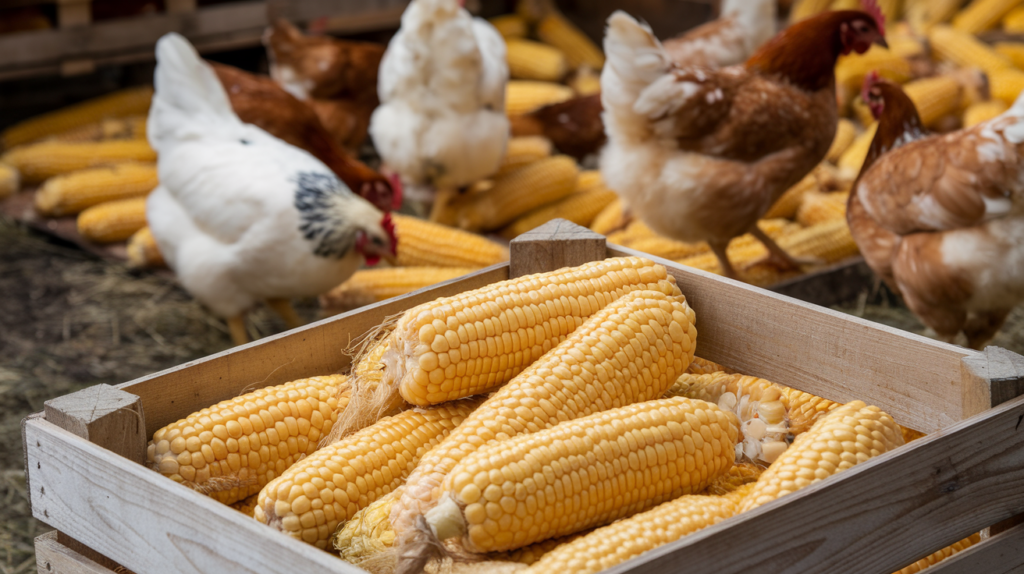
Yellow corn is the main energy source in most chicken feed. In many broiler and layer diets it makes up more than half of the ration, supplying starch for energy and the yellow pigments that colour egg yolks and skin. For feed mills and integrators, buying corn well, at the right quality and price, is one of the biggest drivers of feed cost.
This page is for commercial buyers. If you keep backyard hens, see our guide can chickens eat corn?

Why poultry feed relies on corn
- High energy: corn is rich in starch and has more energy than most other feed grains.
- Pigment: yellow corn contains carotenoids that give yolks and broiler skin their colour.
- Digestibility: low in fibre and easy for birds to digest, usually without enzymes.
- Availability: it is the world’s most traded feed grain.
Corn is low in protein and some amino acids, so it is combined with soybean meal or other protein sources, plus minerals and vitamins. Wheat is a common alternative when it is cheaper. See animal feed wheat.
Typical specification for feed corn
| Parameter | Typical contract limit |
|---|---|
| Grade | Often based on US No. 2 Yellow Corn or an equivalent origin standard |
| Moisture | 14% to 15% maximum |
| Broken kernels and foreign material | Limited by grade, often a few percent |
| Damaged kernels | Limited by grade, including heat damage |
| Aflatoxin | Must meet the limit in your market |
| Other mycotoxins | DON, zearalenone and fumonisins as required |
| Live insects | Nil |
Mycotoxins are the main quality risk in corn. Aflatoxin is a particular concern for poultry. Ask for test results and check them against the feed safety rules in your country.
Main exporting origins
| Origin | Notes |
|---|---|
| United States | The largest exporter; graded under US standards |
| Brazil | Large exports, mainly from the second-crop harvest |
| Argentina | Major exporter to Asia, the Middle East and Africa |
| Ukraine | Important supplier to Europe, North Africa and Asia |
Corn prices
The World Bank maize benchmark averaged $203.20 per tonne in 2025 and was $239.60 per tonne in September 2026. Delivered prices add freight, insurance and handling, and differ by origin and season.
Whole, cracked or ground?
Feed mills usually buy whole corn and grind it themselves, then mix it into mash, crumble or pellets. Whole and cracked corn are also used as scratch grains, mainly for smaller farms. For a comparison, see can chickens eat corn?
How much feed do chickens eat?
As a guide, an adult laying hen eats roughly 120 to 150 grams of complete feed a day, depending on breed, size and weather. Broilers eat more as they grow, reaching around 200 grams a day near the end of the growing period. Corn is part of that total, not the whole of it.
Buying yellow corn through Agromer
Agromer is an international commodity trader based in France since 1985. For feed corn we work with SGS inspection at loading and payment by 100% DLC or SBLC. Send us the grade, moisture and mycotoxin limits, quantity, packaging and destination port. See also yellow corn for animal feed and our range of agricultural commodities.
Frequently asked questions
Why is yellow corn used in chicken feed?
It is high in energy, easy to digest and contains pigments that colour egg yolks and skin.
How much corn is in poultry feed?
In many commercial diets corn makes up more than half the ration, balanced with protein meals, minerals and vitamins.
What is US No. 2 Yellow Corn?
A common US export grade for yellow corn, with limits on test weight, damaged kernels and broken corn and foreign material.
What moisture should feed corn have?
Usually 14% to 15% maximum, to avoid mould in storage and transit.
What is the biggest quality risk with feed corn?
Mycotoxins, especially aflatoxin. Always test each lot.
Which countries export the most corn?
The United States, Brazil, Argentina and Ukraine.