
Agromer Insights: Fertilizers, Commodities & Energy

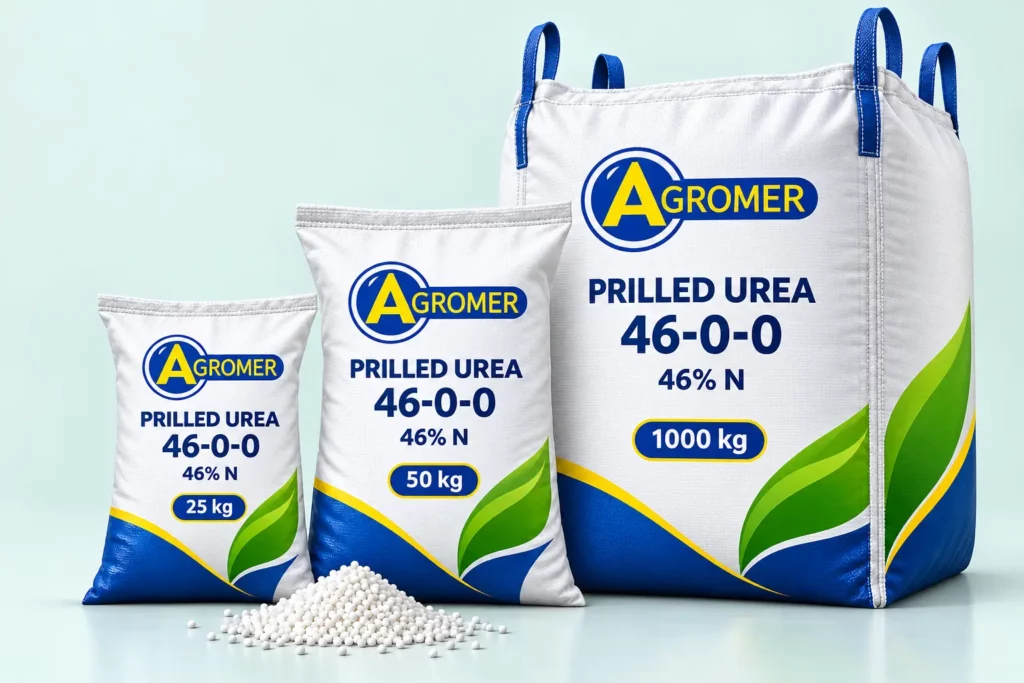
Agromer prilled urea 46-0-0 bags in 25 kg, 50 kg and 1,000 kg sizes with white urea prills

Prilled vs Granular Urea: Differences and Which to Buy

Prilled and granular urea contain the same nutrient, about 46% nitrogen, but the particles are made differently and behave differently. Prilled urea is small and relatively soft. Granular urea is larger and harder. The right choice depends on how the urea will be spread, blended, stored or dissolved. Agromer trades urea for agricultural and industrial

Prilled vs Granular Urea: Differences and Which to Buy Read More »

Infographic: WTI crude oil key characteristics

WTI Crude Oil Specification: API Gravity, Sulphur and Grades Explained

WTI (West Texas Intermediate) is a light, sweet crude oil: typically about 37 to 42 degrees API gravity and less than about 0.5% sulphur. Those two properties make it easy to refine into high-value products such as gasoline, diesel and jet fuel, and they are the starting point of every WTI specification. For supply, see

WTI Crude Oil Specification: API Gravity, Sulphur and Grades Explained Read More »

Infographic: main uses of granular sulfur, from sulphuric acid and fertilizers to metal leaching and chemicals

Granular Sulfur Uses: Sulphuric Acid, Fertilizers and Industry

Granular sulfur is mainly used to make sulphuric acid, the most produced industrial chemical in the world. Most of that acid goes into phosphate fertilizers, and a growing share into extracting copper, cobalt and nickel from ore. Smaller amounts of granular sulphur are used directly as a fertilizer, in rubber and chemicals, and in agriculture.

Granular Sulfur Uses: Sulphuric Acid, Fertilizers and Industry Read More »

Nano Fertilizers: Types, Benefits, Applications and the Future of Agriculture

Nano Fertilizers: Types, Benefits, Applications and the Future of Agriculture

Nano fertilizers are one of the most discussed developments in modern agriculture. As farmers and agricultural companies look for ways to improve nutrient efficiency, reduce waste, and support more sustainable crop production, nanotechnology is creating new possibilities in fertilizer development. But what exactly are nano fertilizers, and how are they different from conventional fertilizers? In

Nano Fertilizers: Types, Benefits, Applications and the Future of Agriculture Read More »

Infographic: tsp vs ssp, two phosphate fertilizers made from phosphate rock

TSP and SSP Fertilizer: Triple and Single Superphosphate Explained

TSP (triple superphosphate) and SSP (single superphosphate) are phosphate fertilizers that supply phosphorus without nitrogen. TSP is concentrated, at about 46% P2O5. SSP is weaker, at about 16 to 20% P2O5, but it also carries sulphur and calcium. Both are made by treating phosphate rock with acid. TSP and SSP at a glance TSP SSP

TSP and SSP Fertilizer: Triple and Single Superphosphate Explained Read More »