
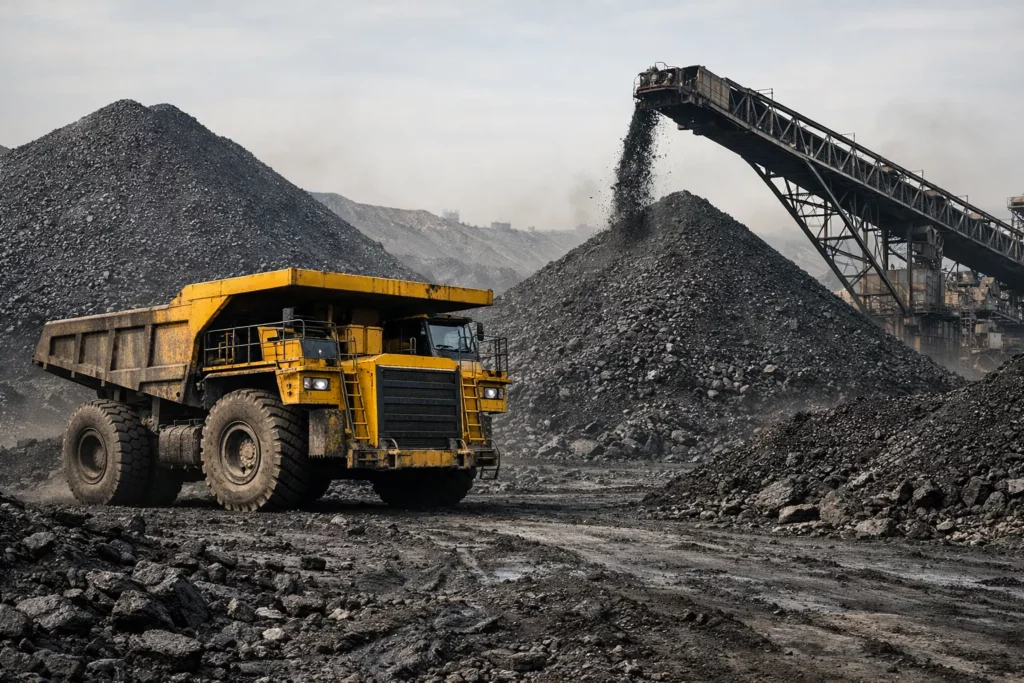
The largest coal suppliers to power plants are national giants such as Coal India and China Shenhua, which mainly serve their home markets, and international miners and exporters such as Glencore, Peabody and Indonesia’s Bumi Resources and Adaro Andalan. For buyers who import, the supplying country matters as much as the company: Indonesia and Australia ship the most coal, and Indonesia dominates seaborne thermal coal.
This guide covers the main producers, the leading exporting countries, 2026 prices and supply risks, and the specifications a power plant should check before buying. Updated October 2026 with the IEA Coal Mid-Year Update 2026.
Coal and power generation in 2026
- World coal demand rose 0.3% to a record 8.84 billion tonnes in 2025. Power generation used about 5,954 Mt of it, by far the largest share.
- For the first time in half a century, coal-fired generation fell in both China and India in 2025, while US coal use rose on strong electricity demand and higher gas prices.
- The IEA now expects demand to grow 1.2% to a new record of 8.94 billion tonnes in 2026, because the energy crisis linked to the conflict in the Middle East has raised LNG prices and pushed some power plants back to coal.
- Global production stayed at about 9.1 billion tonnes in 2025 and is expected to dip around 1% in 2026, while staying above 9 billion tonnes.
Major coal suppliers to power plants

| Company | Base | Main coal operations | What it means for power-plant buyers |
|---|---|---|---|
| Coal India Ltd | India | State-owned; record output of about 781 Mt in FY2024-25, around three quarters of India’s production | Supplies mainly Indian power stations under domestic linkages, not seaborne export |
| China Shenhua Energy (CHN Energy group) | China | Integrated coal mining, rail, ports and power generation | One of the world’s largest producers, focused on the Chinese market |
| Glencore | Switzerland | Thermal coal in Australia, Colombia (Cerrejón, fully owned since 2022) and South Africa; added a majority stake in Canada’s Elk Valley Resources steelmaking coal in 2024 | A leading seaborne thermal coal supplier and trader |
| Peabody Energy | United States | Thermal coal from the Powder River and Illinois basins; seaborne thermal and metallurgical coal from Australia | Large US utility supplier with export capacity |
| Bumi Resources | Indonesia | Thermal coal in Kalimantan through KPC and Arutmin | One of Indonesia’s largest producers and exporters |
| Adaro Andalan Indonesia | Indonesia | Thermal coal in Kalimantan; spun off from Adaro Energy (now AlamTri Resources) in December 2024 | Major source of low-sulfur Indonesian thermal coal |
Two older names you may still see: Yanzhou Coal now trades as Yankuang Energy (parent of Yancoal Australia), and BHP Billiton is now BHP, whose coal business today is mainly metallurgical coal in Queensland, with its Mt Arthur thermal coal mine in New South Wales scheduled to close in 2030.
The largest coal exporting countries
| Country | Thermal coal exports 2025 | 2026 IEA forecast | Typical coal for power plants |
|---|---|---|---|
| Indonesia | 517 Mt (557 Mt in 2024) | About 495 Mt | Sub-bituminous, low ash and low sulfur, higher moisture; priced against the Indonesian Coal Index (ICI) |
| Australia | 209 Mt, plus about 142 Mt of metallurgical coal | About 216 Mt | High-energy bituminous thermal coal, referenced to Newcastle prices |
| Russia | About 130 Mt | About 132 Mt | Bituminous thermal coal; trade with many countries is affected by sanctions |
| Colombia | 45 Mt, the lowest since 2003 | Recovery expected | Bituminous thermal coal, mainly for Atlantic-basin buyers |
| South Africa, United States | Smaller volumes | US exports expected to rise | Bituminous thermal coal for Atlantic and some Asian buyers |
Global coal imports fell about 4% to 1.48 billion tonnes in 2025, mainly because China cut imports from a record 548 Mt to about 495 Mt. Indonesia, Australia and Russia remain the three suppliers that matter most to power plants. See the top coal exporting countries for more detail.
Coal prices and supply risks in 2026
- Prices recovered. Indonesian 4,200 kcal/kg coal rose from about USD 45/t FOB at the start of 2026 to about USD 66/t by the end of August.
- Indonesian policy. Production is expected to fall again in 2026, and debate over export taxes, permits and the possible centralisation of exports through a state-controlled entity adds uncertainty to long-term contracts.
- Atlantic supply. Colombia’s Cerrejón mine declared force majeure on 1 June 2026 after rail blockades, tightening prompt supply to European buyers. South African exports remain limited by rail problems on the Richards Bay corridor.
- Seaborne demand. Seaborne thermal coal demand is projected at about 1,062 Mt in 2026, down from about 1,074 Mt in 2025, as China draws on stocks and buys more from Mongolia.
For power plants this means checking supply security as well as price: a second origin, clear force-majeure terms and an agreed price index all reduce risk.
What a power plant should check before buying
- Calorific value on the basis your contract uses: NAR (net as received) or GAR (gross as received).
- Total moisture, ash and sulfur, which affect boiler efficiency, ash handling and emissions limits.
- Volatile matter and Hardgrove Grindability Index, which must suit your mills and burners.
- Ash fusion temperature, to avoid slagging and fouling.
- Size, delivery terms and price basis: FOB or CIF, and the index used (ICI for Indonesian coal).
- Independent inspection of quality and quantity at loading.
More in key factors when buying coal for power generation, understanding coal grades and the benefits of low-sulfur coal.
Buying Indonesian thermal coal through Agromer

Agromer works under mandate for direct suppliers (accredited export agents) of Indonesian thermal coal, with local representatives in Indonesia who source the coal and arrange the sales and purchase agreement and delivery. Offers cover the NAR and GAR specifications available on the Indonesian market, on FOB or CIF terms, priced against the ICI. An end-buyer Letter of Intent with the full specification is required before a full corporate offer is issued. See coal supply and the Indonesian coal guide.
Frequently asked questions
Who is the largest coal producer in the world?
Coal India is the largest single coal-producing company by output, with about 781 million tonnes in FY2024-25. China Shenhua Energy is among the largest producers. Both mainly supply their domestic markets.
Which country exports the most coal?
Indonesia. It shipped about 517 million tonnes of thermal coal in 2025, followed by Australia (209 Mt of thermal coal, plus about 142 Mt of metallurgical coal) and Russia (about 130 Mt), according to the IEA Coal Mid-Year Update 2026.
What is the difference between NAR and GAR?
Both measure calorific value. GAR (gross as received) includes the heat used to evaporate moisture; NAR (net as received) excludes it, so NAR values are lower for the same coal. Always compare offers on the same basis.
Why do many Asian power plants buy Indonesian coal?
Indonesian thermal coal is low in ash and sulfur, competitively priced and close to major Asian markets. Its higher moisture means lower calorific value per tonne, which boilers and contracts must allow for.
How do I request a coal offer from Agromer?
Send an end-buyer Letter of Intent with the full specification, quantity, delivery terms and discharge port through the quote request form. Agromer then issues a full corporate offer for Indonesian thermal coal.